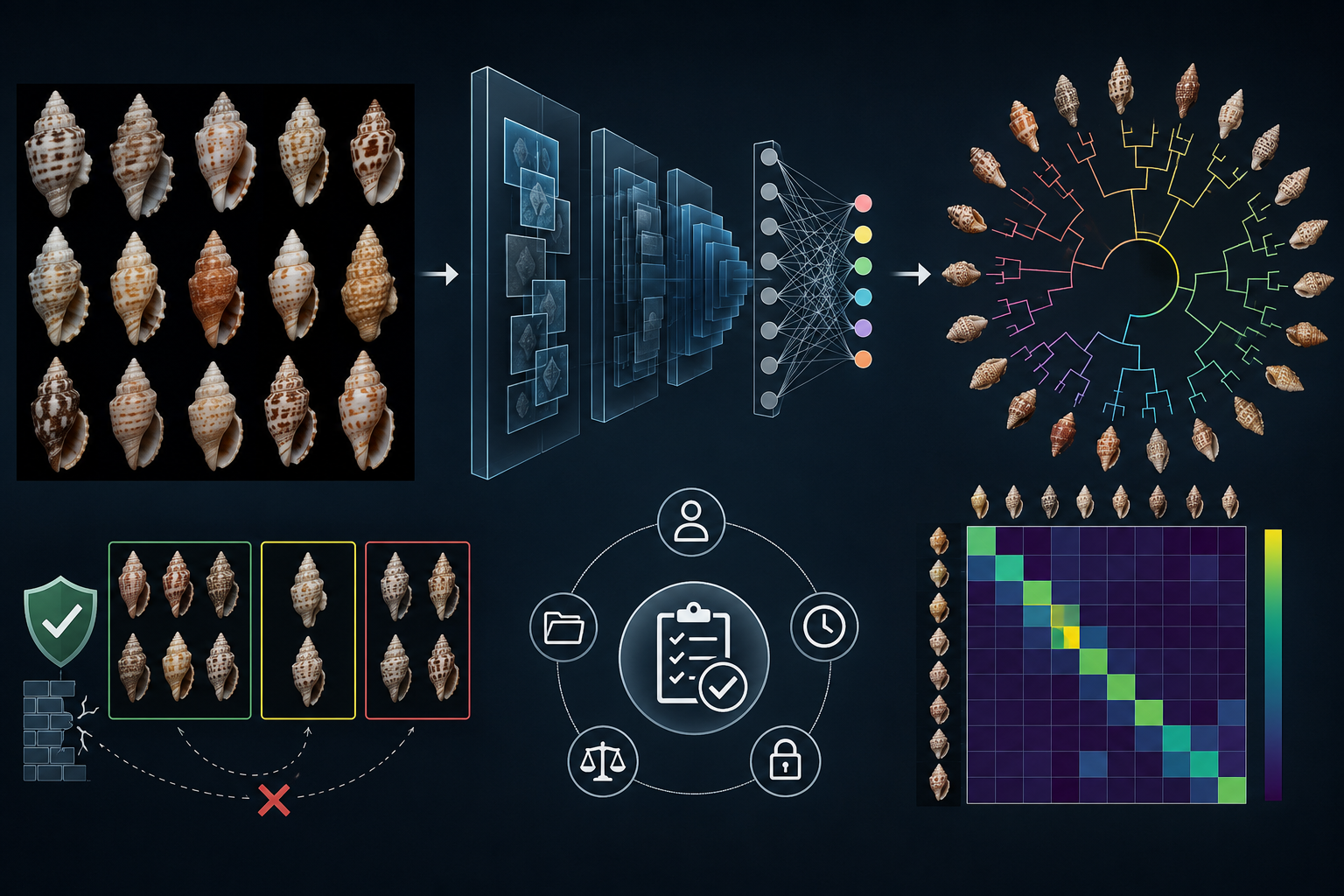
Source-Aware Training Improves Robustness in Leakage-Aware CNN Species Classification of Morum Röding, 1798 (Gastropoda: Harpidae)
Published on: June, 2026

Abstract
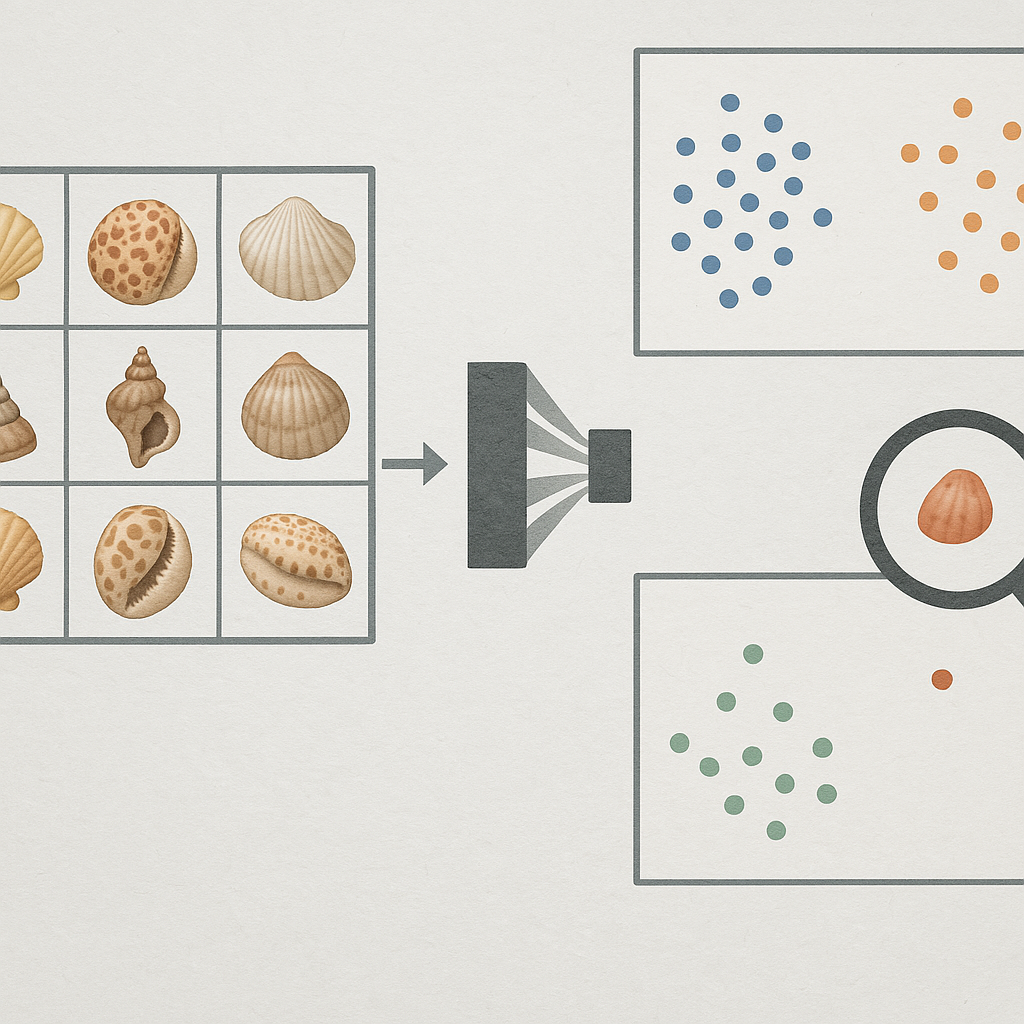
Automated shell identification is a fine-grained biological image-classification problem in which taxonomic similarity, source heterogeneity, repeated specimen views, and class imbalance can strongly affect apparent model performance. This study evaluates a specialist species-level classifier for the gastropod genus Morum under a source-aware and leakage-aware experimental design. A reconciled 20-class Morum dataset was constructed from publicly available conchological image sources, including legacy shell websites, biodiversity aggregators, online marketplaces, and ShellAuction.net. All images were processed using a YOLO-based shell-instance preprocessing pipeline that generated object-centred, black-background shell crops. The final dataset contained 7,010 transformed images, split into 5,617 training and 1,393 validation images using a leakage-aware grouping strategy designed to keep related specimen, listing, source-page, or source-image groups within the same partition.
Using an EfficientNetV2B2-based classifier, the all-source class-balanced baseline reached 85.91% ± 1.03% validation accuracy, with macro F1 of 84.94% ± 1.54% and weighted F1 of 85.88% ± 1.01% across three controlled seeds. However, source-stratified evaluation revealed a substantial ShellAuction/non-ShellAuction validation accuracy gap of 10.13 percentage points. Source-balanced training produced only a modest increase in overall accuracy, reaching 86.77% ± 0.48%, but reduced this source gap to 1.79 percentage points. An old-source-only protocol decreased overall accuracy to 82.63% ± 1.62% and reduced ShellAuction validation accuracy to 61.73%. A count-matched old-source plus ShellAuction mixture recovered performance to 85.95% ± 1.76%, indicating that ShellAuction-style images contributed useful source diversity beyond a simple image-count effect.
Species-level analysis showed that residual errors were structured rather than random, with Morum grande, M. uchiyamai, and M. bayeri remaining the weakest classes despite the overall strong baseline. A metadata-based YOLO audit did not support interpreting most residual errors as preprocessing failures, suggesting roles for visual overlap, viewpoint effects, source-domain variation, and label uncertainty. The recommended model family is therefore the full all-source + class-balanced + source-balanced protocol. This conclusion is limited to the present YOLO-preprocessed, leakage-aware, home/studio-domain Morum dataset and should not be interpreted as evidence of open-world or field-image robustness. More broadly, the study shows that specialist shell classifiers should be evaluated using source provenance, grouped validation splits, species-level diagnostics, source-stratified metrics, and repeated-seed protocol comparisons rather than global accuracy alone.
Introduction
Automated image-based species identification has become an important component of biodiversity informatics. Digital image collections are now produced at scales that exceed the capacity of manual expert review, while reliable taxonomic identification remains essential for collection curation, ecological monitoring, citizen-science workflows, and conservation-oriented triage. Reviews of automated species-identification systems have shown that computer vision can support this process, but also that biological image recognition is rarely a simple generic classification task: species labels are often hierarchical, many classes are visually similar, and image acquisition conditions vary strongly across users, sources, and devices [1, 2]. Large biodiversity benchmarks such as iNaturalist have made these constraints explicit by combining fine-grained species labels, long-tailed class distributions, and heterogeneous real-world photographs [3].
Mollusc shells are a particularly attractive target for image-based identification because they retain taxonomically informative morphology in a compact and durable object. Shell outline, spire form, sculpture, aperture structure, callus development, and colour pattern can all carry diagnostic information. At the same time, shell identification is not visually trivial. The largest widely cited shell-image dataset paper emphasized both the diversity of shell forms and the practical difficulty of species-level recognition, while providing a broad machine-learning resource rather than a specialist, source-aware CNN benchmark [4]. Within this broader shell-recognition problem, the gastropod genus Morum Röding, 1798 represents a useful fine-grained test case. Current WoRMS/MolluscaBase taxonomy treats Morum as an accepted genus within Harpidae, but the genus has a complex systematic history and a literature dispersed across family-level treatments, anatomical work, regional taxonomic papers, and species descriptions [5, 6, 7, 8, 9]. Diagnostic shell characters in Morum and related harpids include reticulate axial and spiral sculpture, nodules or spines, aperture form, outer-lip dentition, parietal and columellar callus, and, in some taxonomic contexts, protoconch morphology and inferred larval development [7, 8, 9, 10]. These features are often localized and subtle, making the problem closer to fine-grained species discrimination than to broad object recognition.
Deep learning has already shown promise for mollusc and shell classification, but the direct literature remains relatively small compared with plant, bird, insect, and general biodiversity-image recognition. Zhang et al. assembled a large shell-image dataset covering thousands of species and evaluated recognition using handcrafted colour, shape, and texture descriptors with classical classifiers [4]. Later shell-related studies moved closer to modern CNN workflows. MorphoNet, for example, applied transfer-learning CNNs to freshwater bivalve images and incorporated YOLO-based localization of shell structures [11]. The recent “Back Home” seashell-classification project further illustrates the practical interest in CNN-based shell identification for conservation and restoration workflows, although its aims differ from those of a controlled specialist benchmark [12]. Taken together, these studies show that shell recognition is a legitimate and developing computer-vision topic, but they leave open a methodological gap: few studies explicitly combine species-level shell classification with source-provenance tracking, leakage-aware splitting of related specimen views, source-stratified evaluation, and controlled comparisons of source composition.
Species-level Morum recognition is naturally framed as a fine-grained visual classification problem. Fine-grained visual classification concerns subordinate categories that share a common global form but differ in localized, often subtle traits. Such tasks are characterized by low inter-class variation and high intra-class variation, and modern reviews emphasize the importance of attention, part localization, and discriminative-region learning [13]. In biological species recognition, supervised attention and object-focused representations can improve sample efficiency by directing the model toward informative structures rather than allowing nuisance variation to dominate [14]. For shell images, this suggests that preprocessing methods that localize the specimen and normalize scale or background may be useful, especially where diagnostic sculpture, aperture details, or shell outline might otherwise occupy only a small part of the full image.
Object-focused preprocessing is therefore a plausible intervention in shell classification. Detection-based cropping can be interpreted as a form of attention that suppresses irrelevant background and forces the classifier to process the target organism or object more directly [15]. In the shell domain, the use of YOLO-style localization in MorphoNet provides a precedent for combining object detection with mollusc-image classification [11]. However, background normalization should not be treated as automatically beneficial. Computer-vision studies on dataset bias and shortcut learning show that image models frequently exploit signals that are predictive within a dataset but not biologically meaningful [16, 17, 18]. Backgrounds can also carry substantial predictive information, even when they are not part of the intended object, and changing or removing them can alter model behaviour [19]. For shell photographs collected from websites, museums, collector pages, and auction platforms, backgrounds, lighting, scale, camera style, and repeated seller setups may become entangled with species labels. YOLO preprocessing may reduce some of these confounds, but it can also introduce a new processed-image domain. Its value therefore needs to be evaluated under controlled conditions rather than assumed.
A related concern is source and domain bias. Heterogeneous web-derived datasets are not independent and identically distributed samples from a single photographic population. Different sources may have characteristic resolutions, lighting conventions, backgrounds, views, and curation practices. Classic work on dataset bias showed that image collections often contain recognizable source signatures, and formal dataset-shift literature provides a framework for understanding why models trained on one distribution may perform differently on another [16, 17]. Shortcut-learning studies further show that deep networks can rely on incidental correlations when these correlations are easier to learn than the intended biological distinction [18]. In the present setting, shell images from commercial auctions, specialist websites, biodiversity aggregators, and older collector sources may therefore differ not only in taxonomic coverage but also in photographic style and label reliability. Evaluating a classifier only by global validation accuracy can obscure these source-associated effects.
Validation design is equally important. Image-level random splitting is problematic when multiple photographs depict the same underlying specimen, listing, lot, or source page. In such cases, dorsal, apertural, lateral, or repeated views of the same shell may be placed in both training and validation sets, allowing the model to benefit from specimen-specific visual information rather than learning class-level features. The broader computer-vision and biomedical-imaging literature has shown that near-duplicate or subject-related leakage can inflate apparent performance and may even alter model rankings [20, 21, 22]. This issue is directly relevant to shell-auction and collection-page data, where multiple views of one physical specimen are common. Leakage-aware grouping by listing, specimen, or source page is therefore not merely a data-cleaning step; it is a prerequisite for interpreting validation accuracy as evidence of generalization.
Class imbalance and stochastic training variability add further uncertainty. Biological image datasets are commonly long-tailed, with abundant images for common or frequently photographed species and few examples for rarer taxa. Class-balanced training or related reweighting strategies can help prevent models from being dominated by high-frequency classes, but they also need to be interpreted carefully because oversampling and source imbalance can interact [23]. Similarly, deep-learning results can vary across random seeds because of differences in initialization, data order, and augmentation trajectories. Single-run reporting can therefore lead to overconfident model-selection claims, especially in moderate-sized biological datasets [24, 25]. A more reliable specialist-classifier study should report repeated runs, species-level metrics, source-stratified performance, and protocol-level comparisons rather than selecting one favourable training run.
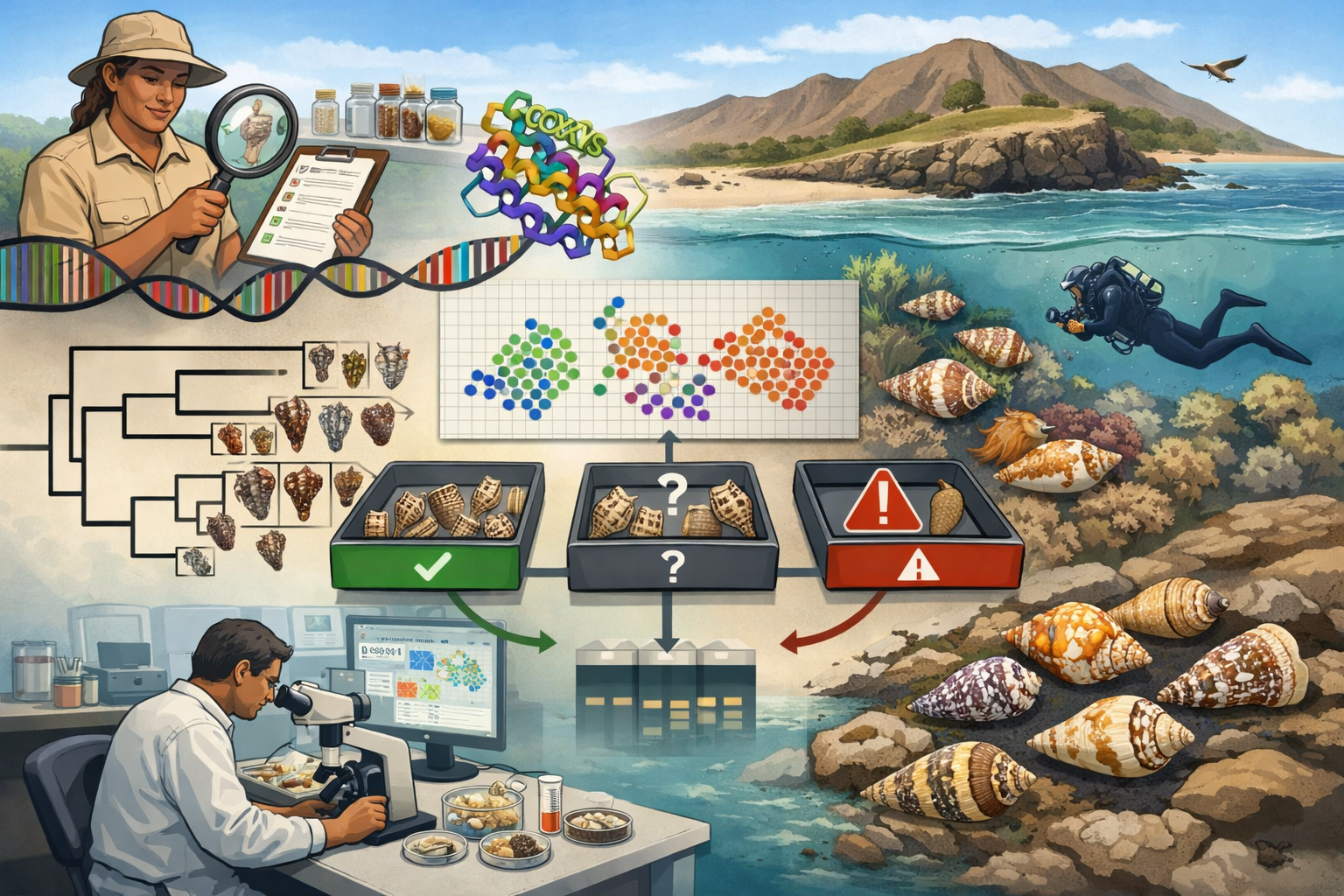
The present study addresses these issues using a controlled species-level classifier for the gastropod genus Morum. The dataset is restricted to home/studio-domain shell photographs processed through the current YOLO-based preprocessing pipeline, and it should not be interpreted as a field-image or unconstrained user-upload benchmark. The study evaluates a reconciled 20-class Morum dataset using a leakage-aware validation split that keeps related images from the same listing, specimen group, or source page within the same partition wherever metadata permit. Rather than asking only which model gives the highest validation accuracy, the study asks whether source diversity, source imbalance, image count, leakage control, and visually fine-grained species overlap can be separated sufficiently to support a cautious model-selection conclusion. To do this, the experiments compare all-source class-balanced training, source-balanced training, old-source-only training, and a count-matched old-source plus ShellAuction mixture under a fixed validation framework. The contribution is therefore methodological as well as practical: it provides a source-aware and leakage-aware evaluation of a specialist Morum classifier, while avoiding claims of field robustness or causal attribution beyond what the controlled comparisons support.
Methods
Study design
This study was designed as a controlled comparison of training protocols for a specialist species-level Morum classifier. The aim was not to select a model from a single best run, but to evaluate how source composition and sampling strategy affected model performance under a fixed validation framework.
All experiments used the same reconciled 20-class Morum image scope (Table S1), the same YOLO-preprocessed home/studio-domain image domain, and the same leakage-aware validation partition. The validation set was kept unchanged across the source-stratified, source-balanced, old-source-only, and count-matched ShellAuction experiments. This allowed protocol differences to be interpreted against a common evaluation substrate rather than being confounded by changes in validation images.
The main protocol families were: natural sampling, all-source class-balanced training, all-source class-balanced plus source-balanced training, old-source-only class-balanced training, and count-matched old-source plus ShellAuction class-balanced training. The all-source class-balanced family served as the principal baseline. The source-balanced family tested whether balancing exposure to ShellAuction and non-ShellAuction images reduced the source-associated validation gap. The old-source-only and count-matched protocols were used to assess whether ShellAuction-style images contributed useful information beyond the effect of increasing the number of training images.
All conclusions are therefore interpreted as protocol-level findings for the current YOLO-preprocessed, leakage-aware, home/studio-domain Morum dataset (Table S1). The study does not evaluate field photographs, unconstrained user-uploaded images, or a pure causal effect of any single factor such as YOLO preprocessing, ShellAuction inclusion, or image count.
Image sources and taxonomic normalization
Shell images were compiled from multiple publicly accessible online sources representing different forms of shell photography, including specialist shell-collecting websites, institutional and university collections, biodiversity aggregators, and online marketplaces. Major sources included GBIF, Malacopics, Femorale, Thelsica, eBay, and ShellAuction.net. A shell dataset created for AI is available [4]. ShellAuction was treated as a distinct source group because it was added later to the Morum dataset and because its listings often contain high-resolution photographs of individual specimens in relatively standardized home or studio-like settings. All non-ShellAuction sources are referred to here as legacy sources because they were collected before the ShellAuction expansion and had been used in earlier model-training workflows.
Source-provided species names were standardized before model training. Names were queried against WoRMS/MolluscaBase using the WoRMS API. When a source name corresponded to a synonym, outdated combination, spelling variant, or otherwise unaccepted name, the accepted WoRMS/MolluscaBase name returned by the API was used as the normalized label. Images for which no accepted species name could be resolved were excluded. After name normalization, the identification provided by the original source or seller was retained as the working label. No independent expert re-identification of every image was performed; labels should therefore be interpreted as source-provided identifications standardized to accepted current nomenclature.
Species-level inclusion was evaluated after name normalization and file reconciliation. Raw image counts were first inspected for each normalized species. For species with low raw-image counts, transformed-image availability was checked manually to determine whether enough YOLO-preprocessed images existed in the current training scope. Species with insufficient transformed-image representation were excluded from controlled model evaluation. This procedure produced the final 20-class Morum scope.
Dataset reconciliation and file-level inclusion criteria
Before model training, candidate Morum images were reconciled across three data layers: source-level metadata, YOLO-transformation metadata, and the transformed image files physically present in the training filesystem. Source-level metadata provided the original taxon label, source provenance, and, where available, source URL, page, listing, or specimen-group information. YOLO-transformation metadata linked each accepted source image to its transformed training image and retained the preprocessing information generated by the detection and segmentation pipeline. The filesystem manifest was then used to verify that the transformed image file was actually available for training.
Only images that could be matched across the required metadata and file layers were retained in the controlled experimental scope. Candidate source records without a corresponding transformed image file were excluded, as were transformed files that could not be traced back to sufficient source and taxonomic metadata. Where multiple metadata records referred to the same transformed file or source image, the file was treated as a single candidate image for the controlled dataset rather than as multiple independent training examples. Conflicting or incomplete records were not used to create additional classes or duplicate entries; such cases were resolved during reconciliation or excluded from the controlled scope if traceability was insufficient.
The term “current files” refers to transformed image files present in the active YOLO-preprocessed training filesystem and traceable to the corresponding source and transformation metadata at the time the dataset was frozen for these experiments. Image counts in this study therefore refer to transformed training or validation images, not to raw source photographs and not to historical candidate records collected in earlier phases of the project. Because the Morum image collection was assembled over multiple collection and preprocessing phases, including the later addition of ShellAuction-derived images and the replacement of earlier rule-based preprocessing by YOLO-based detection and masking, the final experimental dataset should be interpreted as the reconciled current training scope rather than as a complete inventory of all historically collected Morum images.
Species-level inclusion was applied after reconciliation. Only species with sufficient transformed-image representation in the current scope were retained for controlled model evaluation. Species below the inclusion threshold were excluded from the controlled experiment, while species meeting the threshold after reconciliation were retained in the 20-class dataset.
YOLO-based detection, segmentation, and image transformation
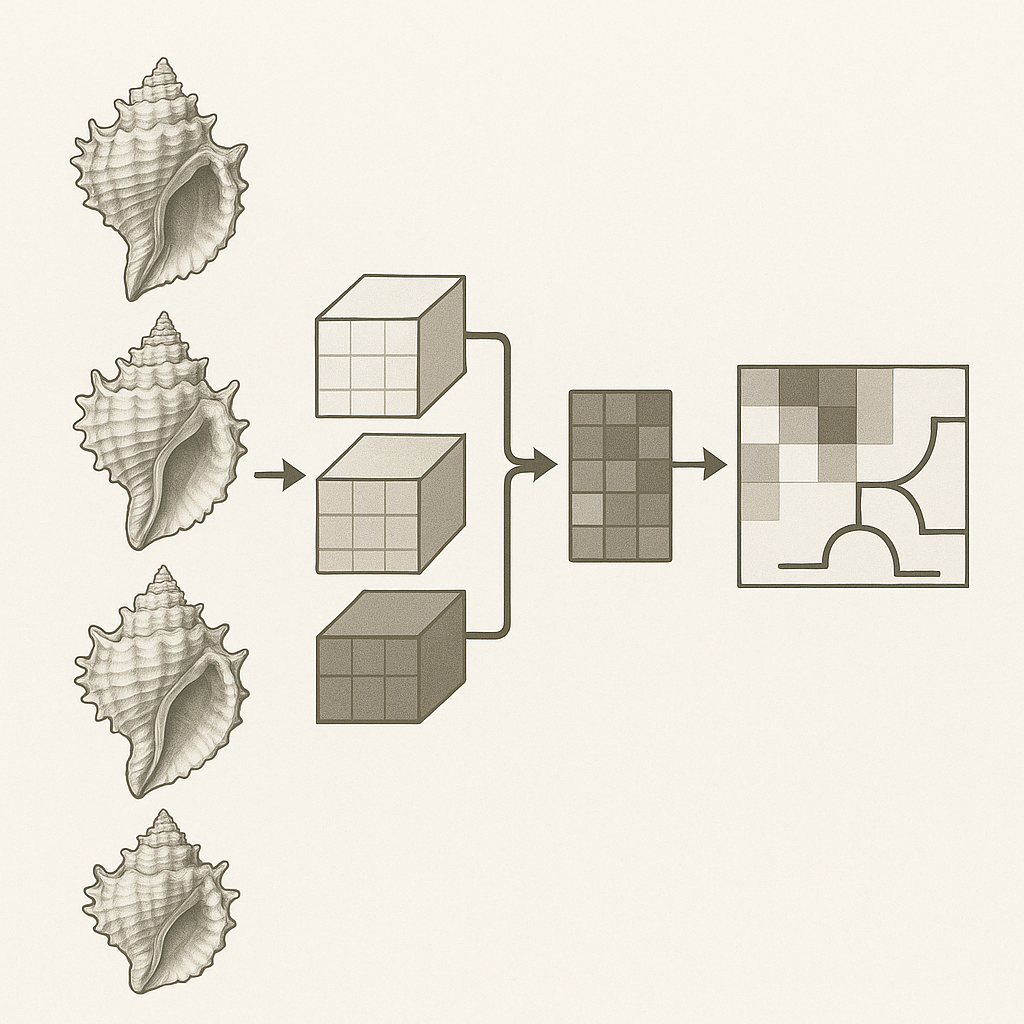
All images in the controlled Morum dataset were processed with the current shell-instance preprocessing pipeline before classifier training. The pipeline used a custom Ultralytics YOLOv8n shell-segmentation model to detect and segment shell instances in the raw source images. YOLO inference was performed with a confidence threshold of 0.35 and an inference image size of 640 pixels.
The preprocessing pipeline used both YOLO bounding boxes and segmentation masks. Bounding-box coordinates, confidence values, mask areas, and related quality metrics were recorded for audit purposes. The transformed training image itself was generated from the segmentation mask. For each detected shell instance, the non-zero mask region was used to define the crop area. A padding value of 0.14 times the largest mask dimension was applied around the mask-derived crop, with a minimum padding of 8 pixels. Crop coordinates were clipped to the original image boundaries when necessary.
Background replacement was performed by pasting the RGB shell region, as defined by the segmentation mask, onto a black background. The masked shell crop was then placed on a square black canvas so that the resulting training image had a standardized object-centred format. Output images were resized only when necessary so that the maximum side length did not exceed 800 pixels. The transformed images were saved as JPEG files and used as the image inputs for the subsequent species-classification experiments
If YOLO detected multiple shell instances in a single source image, each valid segmented instance was exported as a separate transformed image. These instance-level outputs were distinguished by detection index in the transformed filename. Thus, a multi-shell source photograph could contribute more than one shell-instance crop to the training scope. If YOLO returned no bounding box, no segmentation mask, or an empty mask, no transformed crop was generated for that source image. Such cases were recorded as failed or warning cases in the preprocessing metadata when metadata writing was enabled.
All valid YOLO detections above the inference confidence threshold were accepted for transformation unless the mask was empty or no usable crop could be derived. Additional quality diagnostics were recorded, including low-confidence detections, small or very small shell occupancy, poor mask-to-box ratios, crop clipping, multiple detections, and extreme crop magnification. These diagnostics were used for audit and later interpretation of possible preprocessing failure modes, but they were not used as exclusion filters for the main controlled training dataset. The original source image paths were retained in the metadata, but the reported classifier experiments used the YOLO-transformed images rather than a parallel original-image input condition.
Preprocessing diagnostics and YOLO-quality audit
A metadata-based YOLO-quality audit was performed to assess whether classification errors could plausibly be attributed to preprocessing problems. The audit linked validation prediction records to transformed-image metadata and YOLO detection metadata using normalized image paths and image hashes. Its purpose was not to visually reclassify images, but to identify metadata patterns consistent with possible detection, segmentation, crop, or linkage failure.
Image-level diagnostics included YOLO confidence threshold, detection count, no-detection flag, multiple-detection flag, maximum detection confidence, and mean detection confidence. Instance-level diagnostics included selected detection index, selected-instance confidence, bounding-box area ratio relative to the source image, mask area, mask area ratio relative to the source image, mask-to-bounding-box ratio, crop-clipping flags, crop magnification factor, selected-output flag, and selection reason.
Audit flags were divided into hard warnings and soft/contextual flags. Hard YOLO warnings were assigned when an image lacked a matching transformed record, lacked YOLO image metadata, lacked selected-instance metadata, had no YOLO detection, had selected-instance confidence below 0.50, had a bounding-box area ratio below 0.05, or had a mask-to-bounding-box ratio below 0.20 or above 0.95. Soft/contextual flags included medium confidence between 0.50 and 0.70, multiple detections, small shell size, large bounding-box ratio, crop-boundary contact, and extreme magnification of 8.0× or greater. These soft flags were retained for interpretation but were not considered sufficient evidence of preprocessing failure without visual review.
YOLO flags were compared with prediction status, including correct predictions, wrong predictions, high-confidence wrong predictions, consistently wrong images, unstable predictions across runs, species-level error summaries, and recurrent confusion pairs. This allowed classification errors associated with strong preprocessing warnings to be distinguished from errors more plausibly related to visual similarity, viewpoint, source-domain effects, or label uncertainty.
Leakage-aware train/validation partitioning
A leakage-aware train/validation split was constructed to reduce the risk that related views of the same shell, listing, source page, or source image appeared in both partitions. For each image, a preferred grouping key was assigned before splitting. This key represented the best available identifier for keeping potentially related images together. The source of the selected grouping key was also stored.
The grouping key was selected from a fixed priority order. Where available, ShellAuction specimen identifiers were used first, followed by ShellAuction listing identifiers, source page identifiers, source URLs, base image identifiers, shell-record identifiers, and finally the filename as a fallback grouping key. Thus, all images sharing the same preferred split group were treated as a single unit during partitioning. The filename fallback was used only when no stronger specimen-, listing-, page-, or source-level grouping information was available.
The split was generated in a species-stratified manner using a fixed split seed. Images were grouped by split_group_preferred within each species, and whole groups were assigned to validation until the species-level validation target was approached. The target split was 80% training and 20% validation, with no separate test partition in this experiment. This assignment procedure was recorded as a species-grouped, seeded, greedy 80/20 split.
After splitting, several quality checks were applied. First, no "split group preferred" value was allowed to occur in more than one partition. Second, each retained species was required to have both training and validation images. Third, the total number of assigned files was reconciled against the frozen dataset scope, and every included row was required to have either a training or validation assignment. Fourth, the number of retained species and the inclusion or exclusion of borderline species were checked against the final 20-class scope. Finally, both the overall validation ratio and the per-species validation ratios were checked against the intended 20% target.
The final split contained 7,010 transformed image files, of which 5,617 were assigned to training and 1,393 to validation, corresponding to an achieved validation ratio of 19.87%. No preferred split group crossed the train/validation boundary, all 20 retained species were represented in both partitions, and all included files were assigned to one of the two splits. Source composition was also audited after splitting by summarizing train and validation counts by source group and source-domain group. This source-distribution audit was used to document the split composition, but source balance was not enforced as a formal constraint during split construction.
Source provenance and source-domain grouping
Source provenance was retained for each image so that model performance could be evaluated not only by species, but also by image source. Source information was derived from the image metadata generated during data acquisition, including the original source website, source path, source URL, or scraping/source identifier where available. Images with ambiguous or missing source provenance were not included in the controlled source-stratified evaluation.
Two broad source groups were defined. The ShellAuction group consisted of all images scraped from ShellAuction.net. This source was treated separately because it was added later to the Morum dataset and because ShellAuction listings often contain high-resolution photographs of individual specimens in relatively standardized home or studio-like settings. The legacy/non-ShellAuction group consisted of all other conchological image sources. These sources are referred to as legacy sources because they had been scraped before the addition of ShellAuction.net and had already been used in earlier model-training workflows.
Source-domain categories were used for evaluation and interpretation rather than as taxonomic labels. They may reflect differences in photographic style, image resolution, background, specimen orientation, curation practice, and label reliability. Small source-domain strata were reported where useful for transparency, but their interpretation was treated cautiously because small validation counts can make source-specific accuracy and F1 estimates unstable. For this reason, the broad ShellAuction versus legacy/non-ShellAuction comparison was used as the primary source-group contrast, while finer source-domain results were interpreted as descriptive evidence of source-associated variation rather than as definitive causal effects.
CNN architecture and training configuration
All controlled experiments used the same EfficientNetV2-based image-classification framework. The classifier used an EfficientNetV2B2 backbone initialized with ImageNet pretrained weights and without the original ImageNet classification head. YOLO-transformed RGB images were resized to 400 × 400 pixels before being passed to the model.
The model consisted of the EfficientNetV2B2 convolutional backbone followed by global average pooling, batch normalization, dropout, and a dense species-classification layer. The dropout rate was 0.50. The final dense layer produced one output for each retained Morum species class, with L2 kernel regularization of 0.001 and softmax output probabilities.
Training used categorical cross-entropy loss and the Adam optimizer with a learning rate of 0.00020 and batch size 64. Focal loss was implemented as an optional alternative but was not used in the controlled experiments reported here. A maximum of 100 epochs was allowed. Early stopping monitored validation loss with a patience of five epochs and restored the best validation-loss weights. ReduceLROnPlateau reduced the learning rate by a factor of 0.1 after three epochs without validation-loss improvement, down to a minimum learning rate of 1 × 10⁻⁶.
Training used partial fine-tuning. The EfficientNetV2B2 backbone was initially set non-trainable, after which the last 50 backbone layers were unfrozen, while batch-normalization layers in this unfrozen region were kept frozen. No image augmentation was applied during the controlled runs; validation images were not augmented.
Class-balanced and source-balanced training protocols
Sampling modifications were applied only to training paths after the fixed leakage-aware split had been created. The validation set was not resampled, class-balanced, source-balanced, or source-filtered.
Natural sampling used the training paths as loaded from the leakage-aware training folder. The class-balanced protocol oversampled minority species with replacement until each species matched the size of the largest species class within the current training scope. This duplicated existing transformed-image paths; it did not create new images or apply augmentation.
Source-balanced sampling was applied within species. For each species, training images were separated into ShellAuction and other-source groups. Where both groups were present, the smaller group was oversampled with replacement so that the two source groups contributed more evenly within that species. Species represented by only one source group were retained unchanged for source balancing.
The count-matched source-mixture experiment was used to reduce the confounding between ShellAuction inclusion and training-set size. The old-source-only protocol excluded all ShellAuction images from training, producing 5,206 pre-class-balanced training images. The count-matched mixture retained all 411 ShellAuction training images available after the leakage-aware split and removed an equal number of old-source images, producing a mixed pre-class-balanced training set of 4,795 old-source images and 411 ShellAuction images. Replacement was performed in a species-stratified manner: for each species, the available ShellAuction images were retained and the same number of old-source images for that species was removed before class-balanced sampling.
Class-balanced sampling was applied after source filtering or count matching. In both the old-source-only and count-matched mixture protocols, the pre-class-balanced training count was 5,206. After class balancing, each of the 20 retained species was oversampled to 626 training paths, producing 12,520 sampled training paths. In the count-flow tables, “pre-CB N” refers to the number of training images after source filtering or count matching but before class-balanced resampling, whereas “final train N” refers to the sampled training-path count after class-balanced resampling.
Evaluation metrics and statistical summarization
Model performance was evaluated on the fixed leakage-aware validation partition. Overall accuracy was calculated as the proportion of correctly classified validation images. Per-species precision, recall, and F1-score were calculated for each retained species. Macro F1 was calculated as the unweighted mean of species-level F1-scores, giving equal weight to each species. Weighted F1 was calculated as the support-weighted mean of species-level F1-scores, giving greater weight to species with more validation images.
deviation across the three controlled seeds. Species-level tables report the mean and standard deviation of recall, precision, and F1 across the corresponding run family. Confusion patterns were evaluated from the prediction outputs and summarized as recurrent directed or symmetric species confusions across repeated runs.
Source-stratified metrics were calculated by filtering the fixed validation set by source group or source-domain group. The primary source-group comparison contrasted ShellAuction validation images with legacy/non-ShellAuction validation images. The source-group accuracy gap was calculated as the difference between non-ShellAuction validation accuracy and ShellAuction validation accuracy, expressed in percentage points. Source-gap reduction was calculated by comparing this gap between protocols.
Weak-species recall was used as a summary measure for the species that showed lower or diagnostically important baseline performance. These species were selected from the leakage-aware all-source class-balanced baseline, based on low or moderate recall and recurring confusion patterns, and were then tracked in the source-stratified and source-balanced analyses. Because source-domain strata and weak-species subsets can be small, these results were interpreted as descriptive evidence of source-associated robustness rather than as independent statistical proof of source causality.
Results
Dataset reconciliation and leakage-aware evaluation design
The resulting dataset contained 7,010 current Morum image files distributed across 20 species-level classes. Of these, 5,617 images were assigned to the training partition and 1,393 images to the validation partition, corresponding to a validation ratio of 19.87% (Table 1).
A leakage-aware partitioning strategy was used rather than a simple random image split. This was important because source collections may contain multiple images of the same specimen, listing, lot, or source page, often showing different views of the same shell. If such related images were split across training and validation partitions, validation performance could be inflated by near-duplicate or specimen-level leakage. To reduce this risk, related images were grouped using the preferred split-group identifier, based on available listing/specimen metadata, and the partitioning process kept each group within a single split. The split-quality checks confirmed that all included files were assigned to either training or validation, that all species had files in both partitions, and that no preferred split group appeared in more than one partition.
Table 1. Dataset and leakage-aware split summary
| Species/Classes | Total Current Files | Training Images | Validation Images | Split Ratio | Preprocessing Type | Split Type | Grouping/Leakage Control Method |
|---|---|---|---|---|---|---|---|
| 20 | 7,010 | 5,617 | 1,393 | 19.87% | YOLO-based detection and masking | Leakage-aware partition split | Grouping by split_group_preferred (listing/specimen ID) |
Observed split is leakage-aware.
Home/studio-domain Morum images only.
Excludes lorenzi due to low count, includes bayeri and purpureum
This leakage-aware design forms the evaluation basis for all subsequent experiments. As a result, performance estimates obtained from this split may be lower than estimates from earlier random or less controlled splits, but they are expected to provide a more realistic assessment of generalization. The validation set was kept unchanged across the later hyperparameter, source-stratified, source-balanced, old-source-only, and count-matched ShellAuction experiments. This allowed differences between experimental protocols to be interpreted against a stable evaluation substrate rather than being confounded by changes in the validation image set.
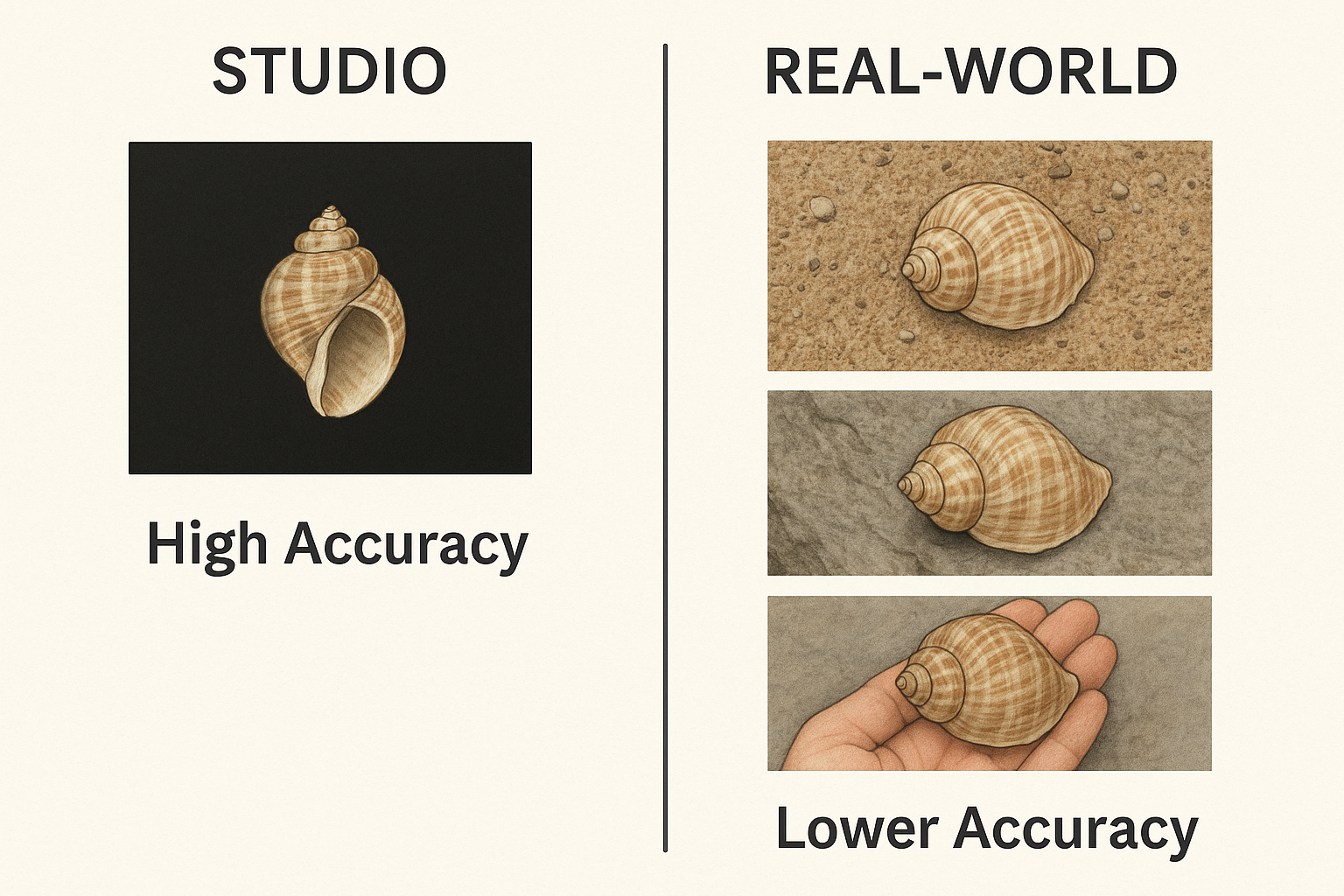
The dataset should also be interpreted within its imaging-domain limits. The Morum images in this experiment represent home/studio-style shell photographs processed through the current YOLO-based pipeline. They do not represent field photographs or unconstrained user-uploaded images from the operational IdentifyShell application. Therefore, the following results address model reliability, source composition, and source-associated robustness within this controlled Morum image domain, rather than general field-image robustness.
Hyperparameter search and selection of the evaluation baseline
After defining the leakage-aware dataset, a series of controlled training runs was used to select a stable evaluation baseline for the subsequent source-composition experiments. The aim of this step was not to exhaustively optimize every possible neural-network parameter, but to identify a reproducible training configuration that could be used consistently across later comparisons. This was important because the main questions of the study concerned source composition, ShellAuction image inclusion, and source-balanced sampling; these effects could only be interpreted if the underlying model configuration and validation split were kept stable.
All controlled experiments used the same EfficientNetV2-based image-classification framework on the reconciled YOLO-preprocessed Morum dataset. Earlier exploratory runs compared historical and expanded datasets, but these runs were not used as the final baseline because several factors had changed simultaneously, including preprocessing, source composition, species scope, and image counts. The later v1a run series therefore focused on the leakage-aware 20-class split and progressively separated the effects of sampling strategy, source balancing, and training-source composition.
The first controlled reference point was a natural-sampling baseline. This run retained the natural class and source distribution of the training set and served as a reference for subsequent sampling changes. However, the Morum dataset remained uneven across species, and several species had substantially fewer training images than the dominant classes. To reduce the influence of class imbalance, subsequent baseline runs used class-balanced sampling. In this protocol, minority species were upsampled during training, while the validation set remained unchanged. The class-balanced all-source runs became the principal baseline family for later comparisons because they used the same leakage-aware validation set, the same model framework, and three independent controlled seeds.
Table 2. Key training protocols and run families
| Run Family | Protocol Label | Class-Balanced | Source-Balanced | Training Source Filter | Count-Matched Mixture | Notes |
|---|---|---|---|---|---|---|
| Natural Sampling Baseline | Natural sampling baseline | No | No | None | No | Baseline reference under natural source/class distribution. 1,393 validation images, no class upsampling |
| All-Source Class-Balanced | All-source + class-balanced | Yes | No | None | No | Baseline for class-balanced training across 3 seeds. Enforces minimum class size via upsampling |
| All-Source Class-Balanced + Source-Balanced | All-source + class-balanced + source-balanced | Yes | Yes | None | No | Candidate model family with source balancing. Balances old-source and ShellAuction images |
| Old-Source-Only Class-Balanced | Old-source-only + class-balanced | Yes | No | Exclude ShellAuction | No | Baseline evaluating removal of ShellAuction source. Confounded by reduced training volume |
| Count-Matched Old + ShellAuction Class-Balanced | Count-matched old + ShellAuction + class-balanced | Yes | No | Count-matched mixture | Yes | Controlled evaluation of source diversity independent of image count. Mixture of 4,795 old + 411 ShellAuction images |
Observed split is leakage-aware. Home/studio-domain Morum images only.
Alternative imbalance-handling strategies, including class weights and focal-loss-based variants, were considered during the hyperparameter search. These approaches were not retained as the main comparison baseline because they complicated interpretation when combined with class-balanced sampling and did not provide the cleanest foundation for the later source-composition experiments. In particular, combining sampling-based balancing with additional loss weighting could overcompensate minority classes and make it harder to attribute performance differences to the experimental factor under study. The final controlled design therefore used class-balanced sampling without additional class weights as the standard baseline for the main source experiments.
The selected baseline was then extended in a structured way to address the later research questions. The all-source class-balanced runs defined the baseline against which source-balanced training was tested. The source-balanced runs used the same seeds as the corresponding class-balanced runs, allowing paired comparisons that isolated the effect of source-balanced sampling. The old-source-only runs used the same class-balanced framework but excluded ShellAuction images from the training set. Finally, the count-matched mixture runs inserted ShellAuction images while removing an equal number of old-source images, allowing a comparison at approximately the same pre-class-balanced training count.
The use of three controlled seeds was central to the final experimental design. Rather than selecting conclusions from a single run, each major protocol was evaluated as a three-run family using the same seed set. This made it possible to distinguish consistent protocol-level effects from seed-specific variation. The class-balanced all-source family was therefore used as the main evaluation baseline, while the source-balanced, old-source-only, and count-matched families were interpreted relative to this baseline or to their paired seed equivalents. Table 2 summarizes these run families and their roles in the subsequent analyses.
Leakage-aware baseline performance and remaining error structure
The all-source class-balanced runs were used as the leakage-aware baseline for evaluating species-level performance before testing source-specific effects. Across the three baseline seeds, the model reached a mean validation accuracy of 85.91% ± 1.03%, with a mean macro F1-score of 84.94% ± 1.54% and a mean weighted F1-score of 85.88% ± 1.01%. The close agreement between overall accuracy and weighted F1 indicates that the model performed consistently across the validation set as a whole, while the lower macro F1 reflects residual variation among species, especially in classes with fewer validation images or visually difficult boundaries.
Table 3. Leakage-aware baseline species-level performance
| Species Name | Validation N | Mean Recall ± SD | Mean Precision ± SD | Mean F1-Score ± SD |
|---|---|---|---|---|
| amabile | 81 | 91.36% ± 1.23% | 80.43% ± 0.17% | 85.55% ± 0.54% |
| bayeri | 14 | 69.05% ± 4.12% | 63.70% ± 16.28% | 65.09% ± 9.35% |
| bruuni | 14 | 100.00% | 100.00% | 100.00% |
| cancellatum | 128 | 77.86% ± 4.58% | 89.33% ± 2.13% | 83.13% ± 2.18% |
| dennisoni | 50 | 93.33% ± 4.62% | 87.74% ± 6.97% | 90.15% ± 2.61% |
| grande | 113 | 61.65% ± 6.64% | 72.75% ± 2.61% | 66.55% ± 2.99% |
| joelgreenei | 153 | 84.97% ± 3.98% | 84.90% ± 3.81% | 84.80% ± 0.99% |
| kurzi | 31 | 81.72% ± 4.93% | 83.48% ± 2.90% | 82.58% ± 3.46% |
| lindae | 22 | 84.85% ± 2.62% | 91.90% ± 4.38% | 88.22% ± 3.18% |
| matthewsi | 133 | 92.98% ± 3.55% | 99.00% ± 1.42% | 95.85% ± 0.88% |
| morrisoni | 10 | 86.67% ± 11.55% | 100.00% | 92.59% ± 5.24% |
| ninomiyai | 76 | 84.21% ± 3.48% | 82.35% ± 8.13% | 82.92% ± 2.57% |
| oniscus | 76 | 80.70% ± 7.25% | 86.84% ± 6.21% | 83.44% ± 4.50% |
| ponderosum | 19 | 84.21% ± 15.79% | 91.82% ± 7.14% | 86.90% ± 5.75% |
| praeclarum | 69 | 95.65% ± 2.51% | 92.15% ± 1.48% | 93.83% ± 0.39% |
| purpureum | 14 | 92.86% ± 7.14% | 71.14% ± 2.80% | 80.38% ± 1.48% |
| teramachii | 84 | 94.05% ± 1.19% | 93.68% ± 0.47% | 93.86% ± 0.32% |
| tuberculosum | 105 | 96.83% ± 1.45% | 95.63% ± 1.09% | 96.21% ± 0.39% |
| uchiyamai | 27 | 67.90% ± 4.28% | 54.25% ± 3.14% | 60.14% ± 0.56% |
| watanabei | 174 | 90.42% ± 5.76% | 83.41% ± 3.68% | 86.59% ± 1.21% |
Species recall/accuracy statistics are calculated as the mean and standard deviation across the three baseline seeds (v1a42, v1a44, v1a45). Home/studio-domain Morum images only.
Species-level performance varied substantially across the 20 Morum classes (Table 3; Figure 3). Several species were classified with high and stable recall, including Morum bruuni, M. tuberculosum, M. praeclarum, M. teramachii, M. matthewsi, and M. dennisoni. These classes showed recall values above 90% in the baseline family, suggesting that their visual features were sufficiently consistent under the current YOLO-preprocessed home/studio-domain image setting. In contrast, a smaller group of species showed consistently weaker performance. The lowest recall values were observed for M. grande (61.65% ± 6.64%), M. uchiyamai (67.90% ± 4.28%), and M. bayeri (69.05% ± 4.12%). Additional species with moderate weakness included M. cancellatum, M. oniscus, M. kurzi, M. ninomiyai, M. ponderosum, and M. lindae. These species were therefore treated as weak or diagnostically important classes in the subsequent source-stratified and source-balanced analyses.
The error structure was not random across species. The most prominent recurring confusion involved M. grande, especially misclassification as M. joelgreenei and, to a lesser extent, M. amabile. This is consistent with the low recall and moderate F1-score of M. grande in the baseline evaluation. Other repeated confusion patterns included M. joelgreenei predicted as M. watanabei, M. cancellatum predicted as M. watanabei or M. ninomiyai, and M. ninomiyai predicted as M. watanabei. These patterns suggest that residual errors are concentrated in a limited set of visually overlapping species groups rather than being evenly distributed across the full 20-class problem.
The weaker species were not necessarily those with the smallest validation counts. For example, M. grande had 113 validation images but remained the lowest-recall class, whereas M. bruuni and M. purpureum had only 14 validation images each but achieved high recall. This indicates that class size alone does not explain the remaining error structure. Instead, the errors likely reflect a combination of visual similarity, shell orientation, source-domain differences, and possible label uncertainty. Some classes may be represented by heterogeneous viewpoints or by images where the diagnostic characters are partly obscured or not emphasized by the selected view.
The YOLO metadata audit did not support interpreting all residual errors as preprocessing failures. Hard YOLO warnings were rare, and several weak species had low rates of hard preprocessing warnings despite poor recall. This suggests that many errors are more likely to arise from visual ambiguity, unusual viewpoints, source-specific photographic style, or incorrect/non-expert labels than from failed shell detection alone. The remaining error structure therefore provides a natural bridge to future work focused on label validation and viewpoint-aware evaluation.
This leakage-aware baseline establishes the reference point for the source-composition experiments that follow. It shows that the model achieves strong overall performance under a more conservative split, but also that a subset of species remains difficult. The subsequent analyses therefore ask whether these remaining weaknesses are associated with image source, ShellAuction inclusion, source-balanced training, or training-set composition.
Source-stratified performance differences
After establishing the leakage-aware all-source class-balanced baseline, validation performance was stratified by image source to test whether residual errors were associated with source provenance. The same fixed validation set was used throughout this analysis, and the stratification was performed on the class-balanced repeat runs. This allowed the effect of source group and source-domain membership to be evaluated without changing the validation images.
Table 4. Source-stratified validation performance
| Stratification | Source Cohort | Validation N | Mean Accuracy ± SD | Mean Macro F1 ± SD | Mean Weighted F1 ± SD | Weak-Species Recall |
|---|---|---|---|---|---|---|
| SOURCE GROUP LEVEL | ||||||
| Source Group | Legacy / Non-ShellAuction | 1,231 | 87.08% ± 0.77% | 85.27% ± 1.39% | 86.94% ± 0.84% | 77.33% |
| Source Group | ShellAuction.net | 162 | 76.95% ± 3.05% | 76.31% ± 5.25% | 77.31% ± 3.16% | 73.70% |
| SOURCE DOMAIN LEVEL | ||||||
| Source Domain | other
|
368 | 88.13% ± 0.68% | 86.75% ± 0.08% | 88.17% ± 0.81% | 81.28% |
| Source Domain |
conchology
|
232 | 95.69% ± 0.43% | 94.05% ± 0.76% | 96.25% ± 0.76% | 84.72% |
| Source Domain | ebay
|
197 | 67.17% ± 3.38% | 78.17% ± 3.16% | 66.81% ± 5.58% | 42.08% |
| Source Domain |
femorale
|
164 | 89.23% ± 0.35% | 88.30% ± 2.41% | 90.66% ± 0.32% | 86.43% |
| Source Domain |
shellauction
|
162 | 76.95% ± 3.05% | 76.31% ± 5.25% | 77.31% ± 3.16% | 71.90% |
| Source Domain | sfc
|
89 | 95.88% ± 2.34% | 96.66% ± 1.71% | 96.69% ± 2.25% | 93.33% |
| Source Domain |
gastropods
|
77 | 92.21% ± 4.50% | 96.37% ± 2.57% | 95.45% ± 2.78% | 76.92% |
| Source Domain |
caledonian
|
39 | 84.62% ± 6.78% | 87.62% ± 6.35% | 89.44% ± 4.87% | 0.00% |
| Source Domain |
allspira
|
38 | 87.72% ± 1.52% | 83.00% ± 0.29% | 88.57% ± 0.78% | 60.00% |
| Source Domain | gbif
|
27 | 90.12% ± 2.14% | 91.31% ± 1.72% | 90.65% ± 1.79% | 90.74% |
Observed split is leakage-aware. Home/studio-domain Morum images only.
At the broad source-group level, validation performance differed between ShellAuction and non-ShellAuction images. Across the three class-balanced baseline runs, non-ShellAuction validation images reached a mean accuracy of 87.08% ± 0.77%, with a mean macro F1-score of 85.27% ± 1.39% and a mean weighted F1-score of 86.94% ± 0.84%. In contrast, ShellAuction validation images reached a mean accuracy of 76.95% ± 3.05%, with a mean macro F1-score of 76.31% ± 5.25% and a mean weighted F1-score of 77.31% ± 3.16%. This corresponds to a ShellAuction/non-ShellAuction accuracy gap of 10.13 percentage points under the all-source class-balanced baseline.
The direction of this source-group difference was consistent across the three class-balanced repeats. In each repeat, ShellAuction validation images were classified less accurately than non-ShellAuction validation images. This does not demonstrate that ShellAuction images caused the errors, because the source groups also differ in species composition, photographic style, view distribution, and possibly label reliability. However, it shows that the residual error structure was associated with image-source group and was therefore important to consider in later training experiments.
Performance also varied across more specific source-domain groups. Among the source domains summarized in the source-stratified evaluation, eBay was the lowest-performing reliable domain, with a mean accuracy of 67.17% ± 3.38% across the class-balanced repeats. ShellAuction also performed below the overall class-balanced baseline, with a mean accuracy of 76.95% ± 3.05%. In contrast, several domains performed above the overall baseline. SFC had the highest mean accuracy, 95.88% ± 2.34%, followed closely by Conchology, with 95.69% ± 0.43%. Other domains such as Femorale, Gastropods, GBIF, and the general “Other” category also showed higher mean accuracy than ShellAuction and eBay, although the interpretation of smaller strata should remain cautious.
Weak-species performance showed a similar source-associated pattern. Across weak species, recall was 75.63% on legacy/non-ShellAuction images and 72.86% on ShellAuction images. The lowest weak-species source-domain result reported in the source-stratified summary was eBay, where weak-species recall was 40.31%. This indicates that the species already identified as difficult under the leakage-aware baseline did not perform uniformly across image sources. Some weak-species failures were therefore not only species-specific but also source-associated.
These results establish that source provenance is a relevant axis of model performance in the Morum dataset. The observed differences should be interpreted as source-associated performance differences, not as proof of source causality or source leakage by themselves. Nevertheless, the consistency of the ShellAuction/non-ShellAuction gap across repeated seeds, together with the broader source-domain variation, justified the next experiment: testing whether source-balanced training could reduce the source-associated performance gap while retaining the same leakage-aware validation set.
Source-balanced training reduces the ShellAuction/non-ShellAuction gap
The source-stratified baseline analysis showed a consistent performance difference between ShellAuction and non-ShellAuction validation images. To test whether this source-associated gap could be reduced during training, the all-source class-balanced baseline was compared with a source-balanced training protocol. The comparison was performed using paired seeds, so that each source-balanced run could be evaluated against the corresponding class-balanced run trained with the same seed.
Table 5. Effect of source-balanced training
| Seed | Baseline Accuracy | SB Accuracy | Delta Acc | Base ShellAuction | SB ShellAuction | Base Non-SA | SB Non-SA | Base Gap | SB Gap | Gap Reduction | Macro F1 Delta | Weighted F1 Delta |
|---|---|---|---|---|---|---|---|---|---|---|---|---|
Seed1
|
86.15% | 87.01% | +0.86 pp | 78.40% | 85.19% | 87.16% | 87.25% | 8.77 pp | 2.06 pp | +6.71 pp | +0.59 pp | +0.92 pp |
Seed2
|
84.78% | 87.08% | +2.30 pp | 73.46% | 83.33% | 86.27% | 87.57% | 12.81 pp | 4.24 pp | +8.58 pp | +1.91 pp | +2.09 pp |
Seed3
|
86.79% | 86.22% | -0.57 pp | 79.01% | 87.04% | 87.81% | 86.11% | 8.80 pp | -0.93 pp | +9.73 pp | -1.39 pp | -0.82 pp |
| Mean ± SD | 85.91% ± 1.03% | 86.77% ± 0.48% | +0.86 ± 1.44 pp | 76.95% ± 3.04% | 85.19% ± 1.85% | 87.08% ± 0.77% | 86.98% ± 0.77% | 10.13 ± 2.33 pp | 1.79 ± 2.59 pp | +8.34 ± 1.52 pp | +0.37 ± 1.66 pp | +0.73 ± 1.46 pp |
Observed split is leakage-aware. Home/studio-domain Morum images only.
Overall validation accuracy changed only modestly after source-balanced training. Across the three paired runs, mean accuracy increased from 85.91% ± 1.03% for the class-balanced baseline to 86.77% ± 0.48% for the source-balanced protocol, corresponding to a mean change of +0.86 percentage points. The direction of the overall accuracy change was not identical in every seed: two paired comparisons improved in overall accuracy, while one showed a small decrease. This indicates that the main effect of source-balanced training was not simply a large increase in global validation accuracy.
The more consistent effect was observed in the ShellAuction/non-ShellAuction performance gap. Under the class-balanced baseline, ShellAuction validation accuracy was 76.95% ± 3.04%, whereas non-ShellAuction validation accuracy was 87.08% ± 0.77%, producing a mean source-group gap of 10.13 ± 2.33 percentage points. After source-balanced training, ShellAuction validation accuracy increased to 85.19% ± 1.85%, while non-ShellAuction validation accuracy remained similar at 86.98% ± 0.77%. The resulting mean source-group gap decreased to 1.79 ± 2.59 percentage points.
This reduction was observed in all three paired comparisons. For seed 180441, the source-group gap decreased from 8.77 pp to 2.06 pp. For seed 181336, it decreased from 12.81 pp to 4.24 pp. For seed 20260622, the gap changed from 8.80 pp to −0.93 pp, indicating that ShellAuction validation accuracy was slightly higher than non-ShellAuction validation accuracy in that paired source-balanced run. Across the three seeds, the mean gap reduction was 8.34 ± 1.52 percentage points.
These results indicate that source-balanced training improved source robustness under the current Morum configuration. The improvement was expressed primarily as a reduction in the ShellAuction/non-ShellAuction performance difference rather than as a large uniform increase in overall accuracy. This interpretation is consistent with the aim of the source-balanced protocol: to reduce source-associated imbalance in training exposure while keeping the same leakage-aware validation set.
The result should be interpreted cautiously. Source-balanced training does not prove that the original performance gap was caused by source style alone, because source groups may also differ in species composition, image viewpoint, label reliability, and photographic conventions. However, the paired-seed comparison shows that changing the training sampling strategy was sufficient to reduce the source-associated validation gap consistently across repeated runs. This supported retaining the full all-source, class-balanced plus source-balanced protocol as a candidate model family for later comparison.
Excluding ShellAuction from training harms performance
To evaluate the practical importance of ShellAuction images in the current YOLO-preprocessed Morum dataset, a separate old-source-only training condition was tested. In this experiment, ShellAuction images were removed from the training set, while the leakage-aware validation set was kept unchanged. The old-source-only runs were compared with the all-source class-balanced baseline runs, using the same validation image set of 1,393 images.
Table 6. Effect of excluding ShellAuction from training
| Protocol | Train Before Filter | Train After Filter | Final Sampled Train | Mean Accuracy ± SD | Mean Macro F1 ± SD | Mean Weighted F1 ± SD | ShellAuction Val Acc | Non-ShellAuction Val Acc | Source Gap |
|---|---|---|---|---|---|---|---|---|---|
| All-Source Class-Balanced Baseline | 5,617 | 5,617 | 5,617 | 85.91% ± 1.03% | 84.94% ± 1.54% | 85.88% ± 1.01% | 76.95% | 87.08% | 10.13 pp |
| Old-Source-Only + Class-Balanced | 5,617 | 5,206 | 12,520 | 82.63% ± 1.62% | 79.27% ± 2.09% | 82.58% ± 1.55% | 61.73% | 85.38% | 23.65 pp |
Both configurations are evaluated on the same validation set (N = 1,393). Observed split is leakage-aware. Home/studio-domain Morum images only.
Removing ShellAuction affected the training composition and reduced the number of unique training images before class-balanced sampling. The all-source class-balanced baseline used 5,617 training images before filtering, whereas the old-source-only condition retained 5,206 images after excluding ShellAuction. The old-source-only runs were then trained with class-balanced sampling, producing 12,520 final sampled training paths. Therefore, this experiment does not isolate a pure source effect: it combines removal of one source domain with a reduction in unique training-image volume.
Despite this limitation, the performance change was clear. Mean validation accuracy decreased from 85.91% ± 1.03% in the all-source class-balanced baseline to 82.63% ± 1.62% in the old-source-only condition, corresponding to a decrease of 3.28 percentage points. Mean macro F1 decreased from 84.94% ± 1.54% to 79.27% ± 2.09%, and mean weighted F1 decreased from 85.88% ± 1.01% to 82.58% ± 1.55% (Table 6).
The largest effect was observed on ShellAuction validation images. When ShellAuction images were included in training, the ShellAuction validation subset reached 76.95% accuracy. When ShellAuction was excluded from training, accuracy on this same validation subset dropped to 61.73%, a decrease of 15.23 percentage points. In contrast, performance on non-ShellAuction validation images changed only modestly, from 87.08% to 85.38%, a decrease of 1.71 percentage points.
As a result, the source-group gap increased substantially. Under the all-source class-balanced baseline, the ShellAuction/non-ShellAuction validation accuracy gap was 10.13 percentage points. Under old-source-only training, this gap increased to 23.65 percentage points. This indicates that excluding ShellAuction from training did not primarily harm all validation images equally; the loss was concentrated most strongly in the ShellAuction validation subset.
These results show that ShellAuction images contributed useful training information under the current Morum YOLO pipeline. However, the experiment should be interpreted as an old-source-only practical baseline rather than as proof of a pure ShellAuction source effect. Because ShellAuction removal also reduced the number of unique training images, the observed performance loss may reflect both reduced source diversity and reduced training volume. This limitation motivated the subsequent count-matched ShellAuction mixture experiment, which tested whether adding ShellAuction-style images still helped when the pre-class-balanced training count was approximately held constant.
Count-matched ShellAuction mixture shows a source-diversity-associated benefit
The old-source-only experiment showed that excluding ShellAuction from training reduced performance, especially on ShellAuction validation images. However, that experiment was confounded by training-set size, because removing ShellAuction also reduced the number of unique training images. To reduce this image-count confound, a count-matched ShellAuction mixture experiment was performed. In this experiment, the old-source-only condition was compared with a mixed old-source plus ShellAuction condition at approximately the same pre-class-balanced training count.
Table 7. Count-matched ShellAuction mixture experiment
| Protocol / Comparative Step | Pre-CB N | SA Train N | Old Train N | Final Train N | Val N | Mean Accuracy ± SD | Mean Macro F1 ± SD | Mean Weighted F1 ± SD | ShellAuction Val | Non-ShellAuction Val | Source Gap |
|---|---|---|---|---|---|---|---|---|---|---|---|
| A: Old-source-only + class-balanced | 5,617 | 0 | 5,206 | 12,520 | 1,393 | 82.63% ± 1.62% | 79.27% ± 2.09% | 82.58% ± 1.55% | 61.73% | 85.38% | 23.65 pp |
| B: Count-matched old + ShellAuction + class-balanced | 5,617 | 411 | 4,795 | 12,520 | 1,393 | 85.95% ± 1.76% | 84.26% ± 2.06% | 85.89% ± 1.61% | 77.78% | 87.03% | 9.25 pp |
| Delta B minus A (Diversity effect at matched size) | +3.33 pp | +4.99 pp | +3.31 pp | +16.05 pp | +1.65 pp | -14.40 pp | |||||
| C: Full all-source + class-balanced | 5,617 | 0 | 5,617 | 5,617 | 1,393 | 85.91% ± 1.03% | 84.94% ± 1.54% | 85.88% ± 1.01% | 76.95% | 87.08% | 10.13 pp |
| Delta C minus B (Volume effect) | -0.05 pp | +0.68 pp | -0.02 pp | -0.82 pp | +0.05 pp | +0.88 pp | |||||
| D: Full all-source + class-balanced + source-balanced | 25,040 | 0 | 25,040 | 25,040 | 1,393 | 86.77% ± 0.48% | 85.31% ± 0.34% | 86.61% ± 0.49% | 85.19% | 86.98% | 1.79 pp |
| Delta D minus C (Balancing effect) | +0.86 pp | +0.37 pp | +0.73 pp | +8.23 pp | -0.11 pp | -8.34 pp | |||||
| Delta D minus B (Balancing + volume effect) | +0.81 pp | +1.05 pp | +0.71 pp | +7.41 pp | -0.05 pp | -7.46 pp |
Protocol runs are: A , B , C , D . Observed split is leakage-aware. Home/studio-domain Morum images only.
Four protocols were compared using the same leakage-aware validation set. Protocol A was the old-source-only class-balanced condition. Protocol B was the count-matched old plus ShellAuction class-balanced condition, in which ShellAuction images were added while an equal number of old-source images were removed. Protocol C was the full all-source class-balanced baseline, and Protocol D was the full all-source class-balanced plus source-balanced condition.
The main comparison was Protocol B versus Protocol A. At approximately the same pre-class-balanced training count, the count-matched old plus ShellAuction mixture improved mean validation accuracy by 3.33 percentage points relative to the old-source-only condition. Mean accuracy increased from 82.63% ± 1.62% in Protocol A to 85.95% ± 1.76% in Protocol B. The same comparison also showed an increase in macro F1 of 4.99 percentage points and an increase in weighted F1 of 3.31 percentage points. This indicates that adding ShellAuction-style training examples improved performance even when the total pre-class-balanced training count was controlled.
The largest improvement occurred on the ShellAuction validation subset. ShellAuction validation accuracy increased from 61.73% in the old-source-only condition to 77.78% in the count-matched mixture condition, a gain of 16.05 percentage points. Performance on the non-ShellAuction validation subset also increased slightly, from 85.38% to 87.03%, corresponding to a gain of 1.65 percentage points. Therefore, the benefit of the count-matched mixture was concentrated most strongly in ShellAuction-style validation images, but it did not come at the expense of the legacy/non-ShellAuction validation subset.
The source-group gap also narrowed substantially. Under Protocol A, the ShellAuction/non-ShellAuction validation accuracy gap was 23.65 percentage points. Under Protocol B, this gap decreased to 9.25 percentage points. The change in source gap was therefore −14.40 percentage points. This supports the interpretation that the count-matched mixture improved source-associated robustness compared with old-source-only training.
The comparison between Protocol C and Protocol B was small. Moving from the count-matched mixture to the full all-source class-balanced dataset changed mean overall accuracy by −0.05 percentage points. This suggests that the count-matched mixture recovered nearly all of the performance obtained by the full all-source class-balanced baseline. In this dataset and configuration, the added benefit of restoring the remaining old-source images was therefore limited relative to the benefit obtained by adding ShellAuction-style diversity at matched count.
Source-balanced training provided an additional, smaller improvement. Protocol D, the full all-source class-balanced plus source-balanced condition, improved mean accuracy by 0.86 percentage points relative to Protocol C and by 0.81 percentage points relative to Protocol B. Protocol D also reduced the source-group gap further, from 10.13 percentage points in Protocol C to 1.79 percentage points. This indicates that source-balanced sampling added robustness beyond simple inclusion of all sources.
The count-matched experiment is therefore the strongest evidence in this study that ShellAuction-style image diversity contributed useful information under the current YOLO-based Morum pipeline. The result should still be interpreted cautiously. It is source-diversity-associated evidence from a practical count-matched comparison, not proof of a pure causal source effect. Nevertheless, because Protocols A and B used approximately the same pre-class-balanced training count and the same leakage-aware validation set, the improvement from A to B shows that the benefit of ShellAuction was not explained only by having more training images.
Final model-selection result
The controlled experiments support selecting the full all-source, class-balanced plus source-balanced run family as the final candidate model family for the current Morum classifier. This protocol corresponds to Protocol D in the count-matched comparison and is summarized schematically in Figure 6.
The selected model family uses the full available training set rather than excluding ShellAuction images, and it combines class-balanced sampling with source-balanced sampling. Across the three controlled seeds, this protocol reached a mean validation accuracy of 86.77% ± 0.48%, with a mean macro F1-score of 85.31% ± 0.34% and a mean weighted F1-score of 86.61% ± 0.49%. It slightly outperformed the full all-source class-balanced baseline, which reached 85.91% ± 1.03% accuracy, corresponding to a mean accuracy difference of +0.86 percentage points.
The main reason for selecting this family is its source-robustness profile. The all-source class-balanced baseline had a ShellAuction/non-ShellAuction validation accuracy gap of 10.13 percentage points. With source-balanced training, this gap decreased to 1.79 percentage points. ShellAuction validation accuracy increased from 76.95% under the all-source class-balanced baseline to 85.19% under the source-balanced protocol, while non-ShellAuction validation accuracy remained similar, changing from 87.08% to 86.98%. Thus, the source-balanced protocol reduced the source-associated performance gap without a large loss on the non-ShellAuction validation subset.
The selected model family also avoids the weakness observed in the old-source-only condition. When ShellAuction images were excluded from training, overall accuracy decreased to 82.63% ± 1.62%, and ShellAuction validation accuracy dropped to 61.73%. In contrast, the full all-source plus source-balanced family retained ShellAuction-derived training information and achieved substantially higher ShellAuction validation performance. This supports the practical decision to retain ShellAuction images in the training set rather than excluding them.
The count-matched experiment further supports this choice. Adding ShellAuction images at approximately the same pre-class-balanced training count improved performance relative to the old-source-only condition, indicating that the benefit of ShellAuction was not explained only by having more training images. Source-balanced training then provided an additional smaller improvement over the full all-source class-balanced baseline and reduced the source-group gap further.
For these reasons, the full all-source + class-balanced + source-balanced protocol is the recommended candidate family for the current Morum model under the YOLO-preprocessed, leakage-aware, home/studio-domain evaluation setting. This recommendation is based on three controlled seeds and on the combined evidence from the source-stratified, source-balanced, old-source-only, and count-matched experiments. It should therefore be interpreted as a protocol-level conclusion for the present Morum dataset, not as a claim based on a single best run or as evidence of field-image robustness.
Discussion
Source-aware training improves robustness
The principal finding is that the recommended Morum model family should be selected for source robustness, not for global accuracy alone. Although the full all-source + class-balanced + source-balanced protocol increased mean validation accuracy only modestly, from 85.91% ± 1.03% to 86.77% ± 0.48%, it reduced the ShellAuction/non-ShellAuction validation gap from 10.13 to 1.79 percentage points.
This distinction is important because heterogeneous shell-image datasets are not neutral collections of independent images. Source websites, auction platforms, collection pages, and biodiversity aggregators may differ in background, lighting, camera setup, image resolution, specimen orientation, and curation practice. Dataset-bias and dataset-shift studies have shown that image collections can carry recognizable source signatures, and shortcut-learning work has shown that CNNs may exploit such incidental signals when they correlate with the target labels [16, 17, 18]. In the present dataset, the lower ShellAuction performance under the all-source class-balanced baseline indicates that source provenance remained a relevant axis of model behaviour even after YOLO-based object-centred preprocessing.
The source-balanced protocol can therefore be viewed as a practical robustness intervention. It did not transform the classifier into a fully domain-general model, and it does not prove that the original source gap was caused by photographic style alone. Source groups may also differ in species composition, viewpoint distribution, label reliability, and specimen quality. Nevertheless, balancing training exposure between ShellAuction and non-ShellAuction images was sufficient to reduce the source-associated validation gap consistently across paired seeds. This result is consistent with the broader domain-generalization literature, which treats source heterogeneity as a central problem for model reliability across acquisition domains [26].
Class-balanced sampling and repeated-seed evaluation make this recommendation a protocol-level conclusion rather than a single-run result. For the present Morum dataset, the all-source + class-balanced + source-balanced family provides the best balance between overall accuracy and source robustness.
Species-level error structure and visual diagnosability
The leakage-aware baseline also shows why overall validation accuracy is not sufficient for interpreting a fine-grained shell classifier. Although the all-source class-balanced baseline reached strong overall performance, species-level recall varied substantially. Several species, including Morum bruuni, M. tuberculosum, M. praeclarum, M. teramachii, M. matthewsi, and M. dennisoni, were classified with high and stable recall. In contrast, M. grande, M. uchiyamai, and M. bayeri remained difficult, and additional moderate weaknesses were observed in species such as M. cancellatum, M. oniscus, M. kurzi, M. ninomiyai, M. ponderosum, and M. lindae. These differences indicate that the classifier’s residual errors were structured by species identity rather than being a uniform consequence of the global model architecture.
This pattern is consistent with the biological and taxonomic nature of Morum identification. The genus contains species that differ by combinations of shell outline, sculpture, nodules or spines, aperture morphology, outer-lip dentition, parietal or columellar callus, colour pattern, and, in some cases, protoconch-related characters or inferred developmental history [5, 6, 7, 8, 9, 10]. Some of these characters may be visible in standard shell photographs, but others are localized, view-dependent, obscured by wear, or difficult to capture in a single image. The taxonomic literature also shows that Morum has a complex systematic history, with accepted names, older combinations, synonyms, regional treatments, and species descriptions distributed across several sources rather than consolidated into a single image-oriented diagnostic framework [5, 6, 7, 8, 9]. It is therefore unsurprising that some species are visually more recoverable by a CNN than others.
The observed confusion structure supports this interpretation. The most prominent recurrent confusion involved M. grande, especially predictions as M. joelgreenei and, less frequently, M. amabile. Other repeated patterns involved M. joelgreenei predicted as M. watanabei, M. cancellatum predicted as M. watanabei or M. ninomiyai, and M. ninomiyai predicted as M. watanabei. Such errors suggest that the model was not failing randomly, but was concentrating its mistakes in a limited set of visually overlapping species groups. In fine-grained visual classification, this is expected: subordinate categories often share the same global object form and differ only in localized or subtle features, while within-class variation can be large because of growth stage, specimen condition, orientation, lighting, and source style [13, 14].
Importantly, weak performance was not explained by image count alone. M. grande had a relatively large validation sample but remained the weakest baseline species, whereas some species with small validation counts achieved high recall. This suggests that residual error depends not only on the number of training or validation examples, but also on visual diagnosability, viewpoint coverage, source distribution, and label reliability. This interpretation is consistent with earlier IdentifyShell analyses on intra- and inter-class variability, outlier detection, Tellinidae visual diagnosability, and large-scale Conus classification, where model performance was most informative when treated as a structured signal about visual recoverability rather than as a single global accuracy number [29, 30, 31].
The species-level results also caution against interpreting every high-confidence error as a technical failure of the preprocessing pipeline. The YOLO metadata audit showed that hard preprocessing warnings were rare and did not account for most residual weak-species behaviour. Many remaining errors are therefore more plausibly explained by visual overlap, unusual viewpoints, source-domain effects, or source-label uncertainty than by failed shell detection alone. This does not mean that the model reveals taxonomic truth, nor that all recurrent confusions correspond to genuine biological ambiguity. Rather, the error structure identifies a focused set of species pairs and image conditions where future expert review, viewpoint-specific evaluation, and label validation would be most valuable.
For this reason, species-level error analysis should be considered part of the scientific output of the classifier. The model does not merely assign names; it highlights which species are visually stable under the current home/studio-domain, YOLO-preprocessed image regime and which remain diagnostically fragile. In this sense, the Morum results extend the broader argument developed in earlier IdentifyShell work: CNN performance can help reveal practical visual diagnosability, but only when interpreted alongside taxonomy, source provenance, leakage-aware validation, and species-level confusion patterns.
Source-domain effects and the value of source provenance
The source-stratified results show that source provenance is not a minor annotation variable, but a central axis of model interpretation. Under the all-source class-balanced baseline, validation performance differed between broad source groups and between finer source-domain categories. ShellAuction validation images performed below legacy/non-ShellAuction images, and eBay was the weakest large source-domain group. In contrast, source domains such as Conchology, SFC, Femorale, GBIF, and several other legacy sources performed substantially better. These differences indicate that a single global validation accuracy can hide important source-associated structure in the classifier’s behaviour.
This result is consistent with broader evidence from biodiversity and computer-vision datasets. The iNaturalist benchmark demonstrated that real-world species-recognition datasets combine fine-grained labels, long-tailed class distributions, and heterogeneous image-acquisition conditions [3]. More generally, dataset-bias and dataset-shift studies have shown that image collections often contain recognizable source signatures and that models trained on one distribution may perform differently on another [16, 17]. Shortcut-learning work further shows that CNNs may exploit incidental correlations when these provide an easier route to classification than the intended biological signal [18]. In shell datasets assembled from public websites, auction platforms, biodiversity aggregators, and collector pages, such incidental correlations may include background material, lighting style, camera setup, image resolution, watermarking, typical viewpoint, and repeated seller or source-page conventions.
These results support treating source provenance as part of the experimental design, not as a post hoc label. Source-domain differences do not prove that background style caused the errors, because domains may also differ in species composition, viewpoint distribution, specimen quality, curation, and label reliability. However, without source stratification, the classifier would appear only as an approximately 86% accurate model, masking stronger and weaker acquisition regimes.
The role of background and context is especially relevant here. Even after YOLO-based cropping and black-background normalization, source-associated differences remained detectable in validation performance. This suggests that object-centred preprocessing reduces but does not necessarily eliminate source effects. Some source signals may persist through specimen orientation, lighting on the shell surface, resolution, sharpness, crop geometry, colour calibration, or the kinds of specimens preferentially photographed by each source. Prior work has shown that image backgrounds can carry predictive information for object recognition and that changing background context can alter model behaviour [19]. In the present study, the persistence of source-domain differences after preprocessing supports the view that source effects are multi-factorial and cannot be reduced simply to “background removed” versus “background present.”
This interpretation is aligned with earlier IdentifyShell analyses. The report on studio versus field imagery showed that photographic domain can strongly affect shell-classifier performance, while Building a New Family-Level Model: Why Generalization Matters emphasized that model selection should not be based only on in-domain accuracy [27, 28]. The data-collection and model-selection work similarly highlighted that multi-source shell datasets are valuable for coverage but introduce heterogeneity that must be tracked rather than ignored [32]. The present Morum study extends these observations to a controlled single-genus experiment by explicitly measuring source-domain performance under a fixed leakage-aware validation split.
The broader domain-generalization literature provides an appropriate conceptual frame for this finding [26]. The Morum classifier is not claimed to solve domain generalization in the strict sense, because the validation data remain within the controlled home/studio-domain image regime and because source groups are not experimentally randomized. However, the results show why source-aware evaluation is essential before claiming robustness. Source provenance reveals whether a model’s performance is evenly distributed across acquisition regimes or concentrated in particular source styles. For specialist shell classifiers trained from heterogeneous web data, reporting source-stratified metrics should therefore be considered a basic robustness check, alongside species-level recall, leakage-aware splitting, and repeated-seed evaluation.
ShellAuction as useful source diversity
The count-matched experiment provides the strongest evidence that ShellAuction-style images contributed useful source diversity to the current Morum classifier. In the old-source-only condition, all ShellAuction images were excluded from training while the validation set remained unchanged. This reduced overall validation accuracy to 82.63% ± 1.62% and produced a marked weakness on the ShellAuction validation subset, where accuracy fell to 61.73%. This result shows that the legacy/non-ShellAuction sources alone did not provide sufficient coverage for images with ShellAuction-like acquisition characteristics.
The old-source-only result, however, was confounded by image count: excluding ShellAuction also reduced the number of unique training images before class-balanced sampling. The count-matched mixture was therefore a more informative comparison. In that protocol, all 411 available ShellAuction training images were retained, while an equal number of old-source images was removed before class-balanced sampling. This kept the pre-class-balanced training count approximately matched to the old-source-only condition while changing the source composition of the training set.
Under this count-matched design, adding ShellAuction images improved mean validation accuracy from 82.63% ± 1.62% to 85.95% ± 1.76%. The largest gain occurred on the ShellAuction validation subset, where accuracy increased from 61.73% to 77.78%. Performance on non-ShellAuction validation images also increased slightly, from 85.38% to 87.03%, indicating that the gain on ShellAuction-style images did not come at the expense of the legacy validation subset. The ShellAuction/non-ShellAuction gap also narrowed from 23.65 percentage points to 9.25 percentage points.
This pattern supports a source-diversity-associated interpretation. ShellAuction images appear to have contributed visual or acquisition-domain variation that was not fully represented in the older sources. Such variation may include different specimen presentation, lighting, background conventions, image resolution, shell orientation, curation style, or species-specific viewpoint coverage. The broader dataset-bias and dataset-shift literature provides the relevant conceptual frame: models trained on heterogeneous image collections can be sensitive to source-specific distributions, and source coverage can influence how well a model generalizes across acquisition regimes [16, 17]. Shortcut-learning studies further caution that this improvement should not be interpreted naively as proof that the model learned only better shell morphology [18].
The result should therefore not be described as a pure causal ShellAuction effect. The experiment did not randomize source assignment, and ShellAuction images may differ from old-source images in multiple coupled ways: photographic style, species composition, specimen quality, seller labelling, resolution, number of views, and curation practice. The count-matched design reduces the simple image-count explanation, but it does not isolate a single mechanism. The most defensible conclusion is that replacing a subset of old-source images with ShellAuction images improved performance under the fixed leakage-aware validation framework, especially for ShellAuction-style validation images.
This finding is consistent with earlier IdentifyShell work on multi-source shell datasets. The data-collection and model-selection report emphasized that broad web-derived image collection improves taxonomic and visual coverage but also introduces source heterogeneity that must be tracked rather than ignored. The large-scale Conus classifier similarly showed that fine-grained gastropod classification benefits from extensive image coverage across many species and sources, while still requiring careful interpretation of class imbalance and dataset composition [31]. The present Morum study adds a more controlled result: source expansion was beneficial even when the pre-class-balanced image count was approximately held constant.
For model selection, this argues against excluding ShellAuction simply because it represents a distinct acquisition source. Removing it made the classifier less robust to ShellAuction-style validation images, whereas retaining it improved source coverage. At the same time, the results also argue against treating source expansion alone as sufficient. The full source-balanced protocol further reduced the ShellAuction/non-ShellAuction gap, showing that source inclusion and source-balanced sampling address related but different problems. ShellAuction added useful diversity; source balancing helped distribute that diversity more evenly during training.
YOLO preprocessing and residual errors
YOLO-based preprocessing was part of all reported Morum experiments, so the results evaluate the classifier within a standardized object-centred image regime. They should not be interpreted as isolating the independent effect of YOLO, because no direct original-image versus YOLO-transformed comparison was included.
The rationale for this preprocessing is consistent with fine-grained visual classification theory. In species-level shell recognition, the diagnostic signal is expected to lie in the shell itself: outline, sculpture, aperture structure, callus, colour pattern, and localized shape features. Object localization can therefore be viewed as a practical attention mechanism that reduces the influence of irrelevant image regions and forces the classifier to process the target specimen more directly [14, 15]. In the mollusc domain, MorphoNet provides a related precedent for combining CNN-based shell-image classification with YOLO-style localization [11]. Earlier IdentifyShell work on YOLO-assisted object-centric preprocessing also showed that shell-centred cropping and background normalization can improve classification under real-world upload conditions, especially when the original images contain clutter, multiple objects, or poorly controlled framing [35].
At the same time, background removal and object-centred preprocessing should be interpreted cautiously. Dataset-bias and shortcut-learning studies show that CNNs can exploit incidental correlations when they are predictive within a dataset, and image background can function either as nuisance variation or as a source of predictive context [18, 19]. Background removal can therefore help when the background is noisy or misleading, as shown in plant-disease image classification studies where segmentation and background cleaning improved CNN performance under cluttered in-situ conditions [33]. However, other work has shown that background removal can also interact negatively with deep pretrained models, regularization, augmentation, or overfitting dynamics [34]. For this reason, black-background YOLO preprocessing should be treated as a controlled design choice, not as an automatically superior representation.
Source-domain differences remained visible after YOLO preprocessing, showing that object-centred black-background crops did not make the dataset source-neutral. Residual source effects may persist through shell orientation, lighting, resolution, crop geometry, specimen selection, or label quality. The YOLO metadata audit also showed that many weak-species errors were not dominated by hard preprocessing warnings, suggesting that visual overlap, viewpoint effects, source-domain variation, and label uncertainty remain important explanations.
This distinction is important for future model improvement. Some YOLO-related problems can be addressed by improving the segmentation model, tuning crop padding, adding visual validation of hard-warning cases, or training on more difficult multi-object and small-shell examples. Other errors require different interventions: expert label review, viewpoint-specific evaluation, additional source diversity, species-pair analysis, or taxonomic reassessment of recurrent confusions. The present results therefore support YOLO preprocessing as a useful object-centred standardization step, but they also show that preprocessing diagnostics must be interpreted together with species-level and source-level error analysis.
The practical conclusion is that YOLO should be retained as part of the current controlled Morum pipeline, but not treated as an explanation for every success or failure. It provides a consistent shell-centred input representation and reduces some background and framing variation, which is compatible with the broader IdentifyShell strategy developed in the YOLO-assisted preprocessing, studio-versus-field, and Conus classification reports [27, 31, 35]. However, the remaining classification errors show that source provenance, visual diagnosability, label reliability, and leakage-aware validation remain necessary even after object-centred preprocessing.
Methodological implications for shell-image classifiers
The broader methodological implication of this study is that shell-image classifiers should not be evaluated as ordinary closed-form image-classification exercises in which a single model is trained and a single accuracy value is reported. Shell datasets assembled from websites, biodiversity aggregators, collection pages, and marketplaces contain multiple interacting sources of variation: taxonomic hierarchy, fine-grained visual overlap, long-tailed class distributions, repeated views of the same specimen, source-specific photographic style, and variable label reliability. A credible evaluation protocol should therefore make these factors visible rather than averaging them away.
The present Morum experiment illustrates a practical framework for doing this. First, taxonomic names were standardized before class inclusion, so that the classifier operated on accepted species names rather than on a mixture of synonyms, spelling variants, and outdated combinations. Second, candidate images were reconciled across source metadata, YOLO-transformation metadata, and actual files present in the training filesystem. Third, validation was constructed with leakage-aware grouping so that related images from the same listing, specimen group, source page, or source image were not split across training and validation. Fourth, performance was evaluated not only globally, but also by species, source group, source domain, weak-species subset, and repeated-seed protocol family.
This design addresses several known weaknesses in biological image-classification studies. Large shell datasets such as the dataset of Zhang et al. demonstrate the feasibility and value of shell-image recognition at scale, but they do not by themselves solve the specialist evaluation problems of leakage, source provenance, and species-level visual diagnosability [4]. Later shell-related work such as MorphoNet and the “Back Home” project further supports the practical relevance of CNNs, transfer learning, and object localization in mollusc or shell classification [11, 12]. The present study extends this line of work by showing how a specialist genus-level classifier can be evaluated under a controlled, source-aware, leakage-aware, and protocol-comparative framework.
The results also support the value of specialist classifiers within a broader hierarchical identification strategy. In fine-grained biological recognition, a single broad classifier may be useful for high-level routing, but species-level discrimination often requires narrower specialist models that focus on visually similar taxa. Earlier IdentifyShell work on hierarchical mollusc identification, CNN taxonomy optimization, Tellinidae, and Epitoniidae developed this strategy from different angles: hierarchical routing, taxonomic model design, visual diagnosability, and family- or genus-specific specialist evaluation [30, 36, 37, 38]. The Morum study adds a further methodological layer by showing that specialist models should also be evaluated for source robustness and source-composition sensitivity.
For future shell-classifier studies, at least five reporting elements should be considered standard. First, source provenance should be retained and reported, because source-domain differences can remain visible even after object-centred preprocessing. Second, related images should be grouped before train/validation splitting wherever specimen, listing, source-page, or image-family metadata are available. Third, class imbalance should be handled explicitly, and the effect of class balancing should be distinguished from the effect of source balancing. Fourth, metrics should include species-level recall and confusion structure, not only global accuracy. Fifth, major conclusions should be based on repeated runs or run families rather than on a single favourable seed.
The importance of leakage-aware splitting is not limited to shell images. Near-duplicate and subject-related leakage can inflate apparent performance in general computer-vision and biomedical-imaging settings [20, 21, 22]. More recent biological machine-learning work has formalized leakage-reduced splitting as a central evaluation problem and proposed tools such as DataSAIL for constructing more realistic splits in biological datasets [39]. Although the present study used a custom grouping strategy rather than DataSAIL itself, the underlying principle is the same: the validation set should test generalization to genuinely independent image groups, not recognition of related images already represented during training.
Finally, the Morum results show that classifier performance can be scientifically informative when interpreted as structured evidence rather than as a leaderboard score. Weak species, recurrent confusion pairs, source gaps, and preprocessing-warning analyses all point to different failure modes. Some errors suggest visual overlap or limited diagnostic visibility; others suggest source-domain mismatch, label uncertainty, or insufficient representation of particular acquisition styles. This is why source-aware and species-aware evaluation should be seen not merely as engineering hygiene, but as a way to connect machine-learning behaviour back to shell morphology, taxonomic practice, and practical visual diagnosability.
Limitations and future work
Several limitations follow directly from the controlled design of this study. First, the classifier was evaluated as a closed-world 20-class Morum model. All validation images belonged to one of the retained species classes, and the experiments did not test rejection of unknown species, non-Morum shells, other mollusc groups, fossils, damaged fragments, or non-shell objects. The results should therefore not be interpreted as an open-world identification system. Future operational use will require an explicit rejection or triage layer for images outside the trained taxonomic scope, as discussed in earlier IdentifyShell work on the open-world problem.
Second, the study used source-provided identifications standardized through WoRMS/MolluscaBase, not independently re-identified specimens. Taxonomic name normalization corrected synonyms, spelling variants, and outdated combinations where an accepted name could be resolved, but it did not verify that every source or seller identification was biologically correct. This is important because Morum taxonomy is complex, with diagnostic characters distributed across shell sculpture, aperture morphology, callus development, protoconch-related information, and regional taxonomic treatments [5, 6, 7, 8, 9, 10]. Some high-confidence “errors” may therefore represent label uncertainty rather than model failure. Future work should prioritize expert review of recurrent confusion pairs, high-confidence wrong predictions, and weak-species images, followed where possible by comparison with curated specimen records or molecularly supported identifications.
Third, the image domain was intentionally restricted to YOLO-preprocessed home/studio photographs. This made the source-composition experiments interpretable, but limits generalization. The selected model should therefore be validated on independent operational images, including mobile photographs, unusual backgrounds, multi-object images, partial shells, and non-standard viewpoints.
Fourth, the study did not isolate the independent effect of YOLO preprocessing. Future experiments should compare original images, black-background YOLO crops, alternative background treatments, and soft-mask or transparent-background representations under the same leakage-aware split.
Fifth, leakage control was limited by the metadata available for grouping. The split grouped images by specimen, listing, source page, source URL, base image, shell record, or filename fallback where possible, and no preferred split group crossed the train/validation boundary. Nevertheless, web-derived shell datasets may contain residual relatedness that is difficult to detect, such as re-used photographs across websites, duplicated seller images, or the same specimen appearing under different pages or filenames. Future dataset construction should strengthen duplicate detection using perceptual hashing, embedding similarity, source-page lineage, and, where appropriate, leakage-reduced splitting frameworks such as DataSAIL [20, 21, 22, 39] .
Sixth, several species and source-domain strata remained small. Class-balanced sampling reduced the influence of species imbalance during training, but it did so by oversampling existing images rather than by adding new biological variation. For low-count species, repeated exposure to the same transformed images may improve optimization without solving the underlying lack of viewpoint, specimen, locality, or source diversity. Earlier IdentifyShell work on the minimum number of images needed for each species and on few-shot Morum classification remains relevant here: low-image species may require targeted data acquisition, few-shot methods, expert-curated exemplars, or explicit uncertainty-aware triage rather than simple oversampling alone.
Seventh, the source-composition results are practical protocol comparisons, not proof of pure causal mechanisms. The count-matched design reduced the image-count explanation, but did not isolate factors such as lighting, viewpoint, label quality, seller style, or species composition. Future work should use matched species-by-source subsets, controlled ablations, and independent source-holdout validation to separate these mechanisms more cleanly.
Finally, the current work focused on classification performance, not on taxonomic revision. The model’s recurrent confusions and weak species should be treated as hypotheses for human review, not as evidence that species boundaries are wrong. The appropriate next step is a human-led triage workflow: inspect high-confidence errors, compare multiple views of the same specimen, check original source labels, review diagnostic morphology, and, where necessary, flag cases for expert or molecular validation. This is consistent with the IdentifyShell view of AI-assisted species delimitation as a prioritization and review tool rather than as an autonomous taxonomic authority.
Practical model-selection conclusion
The practical model-selection conclusion follows from the combined evidence of the source-stratified, source-balanced, old-source-only, and count-matched experiments. The recommended candidate family is the full all-source + class-balanced + source-balanced protocol. This choice is not based only on the highest mean validation accuracy, but on the most operationally sensible balance between accuracy, source robustness, reproducibility, and compatibility with the current YOLO-preprocessed Morum pipeline.
Several considerations support this selection. First, the protocol uses the full available training scope rather than excluding ShellAuction images. The old-source-only experiment showed that removing ShellAuction weakened the classifier, especially on ShellAuction validation images. Second, the count-matched mixture showed that ShellAuction-style images contributed useful source diversity even when the pre-class-balanced training count was approximately held constant. Third, source-balanced training reduced the ShellAuction/non-ShellAuction validation gap while preserving performance on the non-ShellAuction validation subset. The selected protocol therefore avoids the main weakness of the old-source-only condition and reduces the source-associated imbalance observed under the all-source class-balanced baseline.
The decision is also methodologically stronger than selecting a single best run. The final candidate family was evaluated across three controlled seeds, and the recommendation is based on run-family behaviour rather than on one favourable training outcome. This is important because deep-learning results can vary across random seeds, especially in moderate-sized biological datasets [24, 25]. Class-balanced sampling also provided a more appropriate training basis for the long-tailed Morum dataset, reducing the risk that common species dominated the optimization objective [23]. These choices are consistent with earlier IdentifyShell work on EfficientNetV2 fine-tuning, data collection, generalization, and YOLO-assisted preprocessing, where model selection was treated as a balance between performance, stability, and operational robustness rather than a single-score maximization exercise [28, 32, 35].
At the same time, the recommendation remains deliberately limited. Protocol D is the best-supported candidate for the present 20-class, YOLO-preprocessed, leakage-aware, home/studio-domain Morum dataset. It should not be interpreted as proof of field-image robustness, open-world identification ability, or taxonomic correctness of all labels. The selected family is therefore an operational candidate for controlled Morum image classification and a foundation for further validation on independent operational images, expert-reviewed difficult cases, and future source-holdout or viewpoint-aware test sets.
The broader lesson is that model selection for shell identification should combine accuracy with robustness diagnostics. The selected Morum family is not merely the highest-accuracy option; it is the protocol that best fits the evidence, uses available source diversity, reduces a measurable source gap, and remains transparent about its domain limits.
References
- [1] J Wäldchen & P Mäder. Plant Species Identification Using Computer Vision Techniques: A Systematic Literature Review. Archives of Computational Methods in Engineering, 25, 507–543 (2018)
- [2] L C Popescu et al. Classification of animal species via deep neural networks and species distribution modeling: a systematic review.. Artificial Intelligence Review, 58, 230. (2025)
- [3] G Van Horn et al. The iNaturalist Species Classification and Detection Dataset.. In Proceedings of the IEEE/CVF Conference on Computer Vision and Pattern Recognition (CVPR), 8769–8778. (2018)
- [4] Zhang, Q., Zhou, J., He, J. et al. A shell dataset, for shell features extraction and recognition.. Nature, Sci Data 6, 226 (2019)
- [5] MolluscaBase / WoRMS. Morum Röding, 1798. World Register of Marine Species. MolluscaBase / WoRMS (last accessed 7-Jun-2026)
- [6] H A Rehder. The family Harpidae of the world. Indo-Pacific Mollusca, 3(16), 207–274. Biodiversity Heritage Library (1973)
- [7] R N Hughes. Anatomy of the foregut of Morum Röding, 1798, and the taxonomic misplacement of the genus. The Veliger, 29, 91–100 (1986)
- [8] P Bouchet. Protoconchs, dispersal, and tectonic plates biogeography: New Pacific species of Morum (Gastropoda: Harpidae). Journal of Conchology, 37(5), 533–549 (2002)
- [9] E J Petuch & D Berschauer. A Review of the Genus Morum (Gastropoda: Harpidae) in the Western Atlantic, with the Description of Two New Species from Brazil. The Festivus, 52(1), 60–69 (2020)
- [10] D Merle. The spiral cords of the Muricidae (Gastropoda, Neogastropoda): importance of ontogenetic and topological correspondences. Lethaia, 38(4), 371–389 (2005)
- [11] C Dechsupa et al. MorphoNet: A Novel Bivalve Images Classification Framework with Convolutional Neural Network. Engineering Journal, 27(9) (2023)
- [12] A Valverde & L Solano. Back Home: A Machine Learning Approach to Seashell Classification and Ecosystem Restoration. arXiv:2501.04873
- [13] X-S Wei et al. Fine-Grained Image Analysis With Deep Learning: A Survey. IEEE Transactions on Pattern Analysis and Machine Intelligence, 44(12), 8927–8948 (2022)
- [14] A C Rodríguez et al.. Fine-Grained Species Recognition With Privileged Pooling: Better Sample Efficiency Through Supervised Attention. IEEE Transactions on Pattern Analysis and Machine Intelligence, 45(12), 14575–14589 (2023)
- [15] M R Keaton et al. Fine-Grained Visual Classification of Plant Species in the Wild: Object Detection as a Reinforced Means of Attention. CVPR FGVC Workshop (2021)
- [16] A Torralba & A A Efros. Unbiased Look at Dataset Bias. CVPR (2011)
- [17] J G Moreno-Torres et al. A unifying view on dataset shift in classification. Pattern Recognition, 45(1), 521–530 (2012)
- [18] R Geirhos et al. Shortcut learning in deep neural networks. Nature Machine Intelligence, 2, 665–673 (2020)
- [19] K Xiao et al. Noise or Signal: The Role of Image Backgrounds in Object Recognition. arXiv:2006.09994 (2020)
- [20] B Barz & J Denzler. Do We Train on Test Data? Purging CIFAR of Near-Duplicates. Journal of Imaging, 6(6), 41 (2020)
- [21] R Laroca et al. Do We Train on Test Data? The Impact of Near-Duplicates on License Plate Recognition. arXiv:2304.04653 (2023)
- [22] I E Tampu, A Eklund & N Haj-Hosseini. Inflation of test accuracy due to data leakage in deep learning-based classification of OCT images. Scientific Data, 9, 580 (2022)
- [23] Y Cui et al. Class-Balanced Loss Based on Effective Number of Samples. IEEE/CVF Conference on Computer Vision and Pattern Recognition (CVPR), 9260-9269 (2019)
- [24] D Picard. Torch.manual_seed(3407) is all you need: On the influence of random seeds in deep learning architectures for computer vision. arXiv:2109.08203 (2021)
- [25] S Steinert et al. A refined approach for evaluating small datasets via binary classification using machine learning. PLOS ONE, 19 (2024)
- [26] K Zhou et al. Domain Generalization: A Survey. arXiv:2103.02503 (2021)
- [27] Ph Kerremans. Impact of Studio versus Field Imagery on CNN Performance for Mollusc Shell Analysis. IdentifyShell (2025)
- [28] Ph Kerremans. Building a New Family-Level Model: Why Generalization Matters. IdentifyShell (2025)
- [29] Ph Kerremans. Analyzing Intra- and Inter-Class Variability and Detecting Outliers in CNN Seashell Image Classification Models. IdentifyShell (2025)
- [30] Ph Kerremans. Visual Diagnosability in Tellinidae (Mollusca: Bivalvia: Tellinoidea): Genus-First CNN Routing Improves Species-Level Shell Identification. IdentifyShell (2026)
- [31] Ph Kerremans. A Large-Scale CNN for Fine-Grained Conus Shell Identification. IdentifyShell (2025)
- [32] Ph Kerremans. Identifying Shells using Convolutional Neural Networks: Data Collection and Model Selection.. IdentifyShell (2024)
- [33] K KC Kamal et al. Impacts of Background Removal on Convolutional Neural Networks for Plant Disease Classification In-Situ. Agriculture, 11(9), 827 (2021)
- [34] J Liang, Y Liu & V Vlassov. The Impact of Background Removal on Performance of Neural Networks for Fashion Image Classification and Segmentation. arXiv:2308.09764 (2023)
- [35] Ph Kerremans. YOLO-Assisted Object-Centric Preprocessing Improves Family-Level Shell Classification on Real-World User Uploads. IdentifyShell (2026)
- [36] Ph Kerremans. Hierarchical CNN to identify Mollusca. IdentifyShell (2025)
- [37] Ph Kerremans. Optimizing Molluscan CNN Taxonomy: Balancing Hierarchy Simplification, Data Volume, and Augmentation for Improved Classification. IdentifyShell (2025)
- [38] Ph Kerremans. Epitoniidae: Scientific Background, Hierarchical CNN Modelling, and Performance of One Family-Level and Six Genus-Level Models. IdentifyShell (2026)
- [39] R Joeres et al. Data splitting to avoid information leakage with DataSAIL. Nature Communications 16, 3337 (2025)
Table S1. Morum species included in the training dataset
Species-level classes retained for the controlled Morum classifier experiments. Image counts refer to transformed training images, not raw source images, used for training, excluding the images in the validation dataset.
| Short class name | Accepted species name | Transformed images |
|---|---|---|
| amabile | Morum amabile Shikama, 1973 | 326 |
| bayeri | Morum bayeri Petuch, 2001 | 62 |
| bruuni | Morum bruuni (A. W. B. Powell, 1958) | 60 |
| cancellatum | Morum cancellatum (G. B. Sowerby I, 1825) | 511 |
| dennisoni | Morum dennisoni (Reeve, 1842) | 204 |
| grande | Morum grande (A. Adams, 1855) | 452 |
| joelgreenei | Morum joelgreenei W. K. Emerson, 1981 | 617 |
| kurzi | Morum kurzi Petuch, 1979 | 124 |
| lindae | Morum lindae Petuch, 1987 | 98 |
| matthewsi | Morum matthewsi W. K. Emerson, 1967 | 538 |
| morrisoni | Morum morrisoni D. Monsecour, Lorenz & K. Monsecour, 2020 | 46 |
| ninomiyai | Morum ninomiyai W. K. Emerson, 1986 | 306 |
| oniscus | Morum oniscus (Linnaeus, 1767) | 304 |
| ponderosum | Morum ponderosum (Hanley, 1858) | 82 |
| praeclarum | Morum praeclarum Melvill, 1919 | 277 |
| purpureum | Morum purpureum Röding, 1798 | 54 |
| teramachii | Morum teramachii Kuroda & T. Habe, 1961 | 336 |
| tuberculosum | Morum tuberculosum (Reeve, 1842) | 420 |
| uchiyamai | Morum uchiyamai Kuroda & T. Habe, 1961 | 106 |
| watanabei | Morum watanabei Kosuge, 1981 | 694 |
| Total | 5,617 | |
Note: counts are transformed training images generated by the preprocessing pipeline, not raw source-image counts. Species names follow WoRMS/MolluscaBase nomenclature.